
GAA! WinBlows!
I am currently reformatting my hard drive again for the second time in the last month. This time thanks to a crappy uninstall of a program from the Windows Add or Remove Programs tool, which apparently caused an error in the hard drive partition. Well, I was only 3 programs away from having recovered from the last reformat.
Anyway, the point of this post besides a soul-healing rant-a-thon, is to update some information about the link I provided in my last ATI post: upgrading ATI Catalyst and MMC. I noticed during my redownload of the ATI upgrades for my newly re-re-formated hardrive that the link in my previous post to the list of Past Versions of Catalyst and MMC was somewhat misleading. It's not exactly wrong, but it also won't take you directly to the hidden list. I apparently underestimated the strength of ATI's conviction to keep this list out of the mainstream. Unbeknowst to me, the url at the top of the page when the list is displayed in the browser, will not, upon later use, actually take you to the list.
So here are the instructions on how to find this "hidden" list in case you are having as much trouble as I did the first time of navigating the ATI website.
1) Follow this link to ATI.
2) Make sure you allow scripts if you're using a script-blocker in your browser.
3) In the sidebar on the left, scroll down to find your operating system, click on the plus sign next to it (if its a minus you don't need to click). In my case I'm clicking on Win XP.
4) Next, click on the plus sign next to your hardware, in my case All-In-Wonder.
5) Then click on the plus next to Radeon. After doing this you will see an amazing thing: The link to past drivers and MMC versions!
6) Click on the link and be happy! ...At least until you actually try to install or use the software.
See my previous ATI posts for advice and insight about upgrading and using ATI Catalyst, MMC, and Remote Wonder: upgrading ATI Catalyst and MMC, ATI Remote Wonder -- It's a Wonder When it Works!, ATI All-in-Wonder Out of Box Review (includes review of Catalyst drivers), ATI Multimedia Center Out of Box Review, and ATI: TV Leftovers (includes note on some weird icons and how to disable TV-On-Demand).
Tags: ATI All-In-Wonder, Remote Wonder, ATI Catalyst, Catalyst Driver, ATI Multimedia Center
Wednesday, June 21, 2006


Wednesday, June 14, 2006
See A Saturn 5 Rocket from Space!
With Google Earth (newest version) you can see an aging Saturn 5 in Houston, Texas, all the way from space.
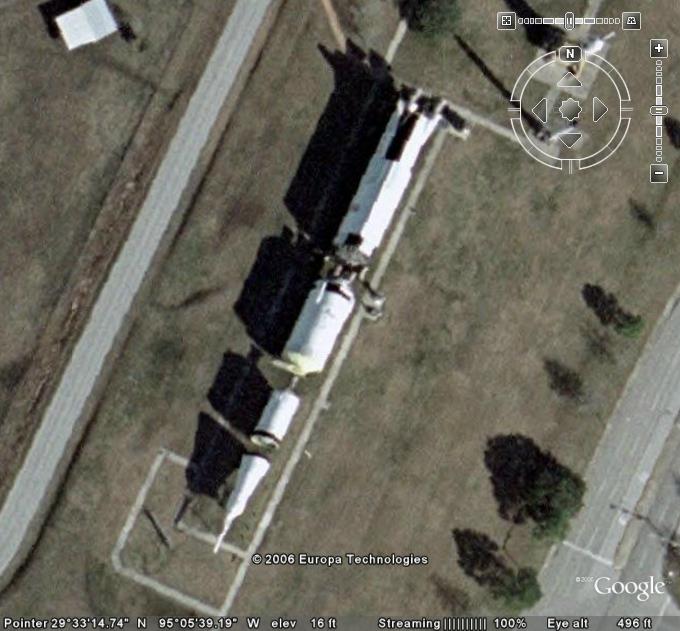
Other cool views:
-Arecibo radio observatory in Puerto Rico

-One of many launch complexes in Baikonur (the Russian spaceport)

With this much coolness, we're sure to find more Google Earth pictures we can't help but share.
:)
Sunday, June 11, 2006
6 (Free) Programs I Can't Live Without
1) Firefox with the RSS ticker extension.
2) Thunderbird (or Netscape Mail). Thunderbird and NS Mail are pretty similar to each other, but Thunderbird is an updated version that can be customized with extensions and RSS reading capabilities.
3) Skype for monitoring webcams. Can easily monitor a webcam, and unlike AIM Trition, you don't have to have a webcam to see someone else's. Skype or Google Talk would be good for instant messaging if more people used it. So for now, I still can't live without AIM either.
4) Microsoft OneNote 2007 (Beta 2). It's free, it's awesome! Actually, I'd have a hard time living without any of the products in the Microsoft Office Suite. But OneNote is definitely the coolest. In fact try all the Beta 2 Office 2007 products now for free at the Microsoft website!
5) Hamachi. Already praised here on Space Race Victory for its ability to overcome networking problems.
AND #6) Unlocker. A free utility that lets you delete files even when Windows says: "Cannot delete Folder: It is being used by another person or program."
Got your own set of Freebies you can't live without?
2) Thunderbird (or Netscape Mail). Thunderbird and NS Mail are pretty similar to each other, but Thunderbird is an updated version that can be customized with extensions and RSS reading capabilities.
3) Skype for monitoring webcams. Can easily monitor a webcam, and unlike AIM Trition, you don't have to have a webcam to see someone else's. Skype or Google Talk would be good for instant messaging if more people used it. So for now, I still can't live without AIM either.
4) Microsoft OneNote 2007 (Beta 2). It's free, it's awesome! Actually, I'd have a hard time living without any of the products in the Microsoft Office Suite. But OneNote is definitely the coolest. In fact try all the Beta 2 Office 2007 products now for free at the Microsoft website!
5) Hamachi. Already praised here on Space Race Victory for its ability to overcome networking problems.
AND #6) Unlocker. A free utility that lets you delete files even when Windows says: "Cannot delete Folder: It is being used by another person or program."
Got your own set of Freebies you can't live without?
Friday, June 09, 2006
The best defense is a good offense
In a story that a lot of other bloggers have noticed, there was a large bolide impact in Norway a few days ago. The force of the explosion equalled Hiroshima, but it happened in a wilderness, and fortunately nobody got hurt.
Once again, just like in Tunguska in 1908 and the infamous near-miss that occurred over the Pacific Ocean at the height of Pakistani-Indian tensions a few years back, we dodged a bullet. If the bolide had hit a large city it would have been a disaster; if it had struck in an ocean the tsunami would kill millions outright.
We live in a cosmic shooting gallery. Even a "small" bolide could kill tens of millions of people. There wouldn't be any time for Gallup polls or talking heads or interviews with "experts" on CNN or Congressional hearings to point fingers at what went wrong or editorials saying "Oops, we really shouldn't have been criticizing the American human spaceflight program for all these years, after all". Civilization would simply end.
Thanks to popcorn fluff like Amageddon and Deep Impact, you probably think that we'd just launch a space shuttle to stop a rogue bolide with our name on it. Unfortunately, with current sensors we'd be darn lucky to get a few hours warning, and by then it would be too late. Although there are some telescopes that are being built that will be on full-time asteroid watching duties, they won't be ready for a few more years. Those goofy movies depicted a far more organized response than anything we could muster currently. There's no secret Air Force manned space launchers. There's no Stargate Command ready to launch space fighters to stop bolides. We don't have sensors constantly scanning the sky looking for bolides. We don't even have spacecraft that can leave low-earth orbit. Heck, we know so little about asteroids that there's some experts who think that a nuclear deflection wouldn't even work. We need robotic and human exploration missions to asteroids to more accurately assess the threat and how to define countermeasures.
Right now, even if we had a few years of lead time, I doubt there's much we can do. We're lucky when the Shuttle flies more than twice a year, and it can't leave low-earth orbit. For the forseeable future, we are simply incapable of defending ourselves. With the Shuttle grounded, we're actually technically no better off than the dinosaurs, and we all know how well that turned out for them.
There's definitely an "Out of sight, out of mind" mentality when it comes to bolide impacts. However, you have to multiply the probability of an asteroid impact (small but actually higher than your chances of perishing in a car accident) by the result of an impact (we all have a really bad day). Seen in that light, NASA's paltry tiny chunk of the Federal Budget (and the even more minuscule sub-percentage of that amount which actually goes towards human space development and asteroid studies), while not as big as it probably should be, is a sound insurance policy.
We're not helpless, but we need time and support to correct what everyone in the know acknowledges is a really scary situation. The only defense against the inevitable is to become a true spacefaring civilization. We need infrastructure, and lots of it, and soon. We're racing against time here, and there's a good chance we could still lose. We need extensive economic development of cislunar space, robust transportation systems, and thriving, permanent communities throughout near-earth space. Only then will we have the means to intercept and deflect a bolide.
This, the creation of the means to stop an incoming asteroid, is in my view the best single reason to aggressively promote and support space settlement and development. It's a case that some people, like Apollo 16 commander John Young and current NASA Administrator Mike Griffin have been making eloquently for many years. However, we have a long way to go. In a recent example of editorial stupidity, the Washington Post proclaimed that the need to preserve human civilization in the face of this kind of threat doesn't justify the short-term expense [which, again I will point out, is far less than 1% of the Federal Budget. We actually spend about 85 times as much money on pizza and beer in the United States] of creating some of the needed infrastructure by returning humans to the Moon. I certainly hope that near-misses like the one that just happened in Norway will help to change minds of the shortsighted and convince people that we need to become a true spacefaring civilization before it's too late.
Once again, just like in Tunguska in 1908 and the infamous near-miss that occurred over the Pacific Ocean at the height of Pakistani-Indian tensions a few years back, we dodged a bullet. If the bolide had hit a large city it would have been a disaster; if it had struck in an ocean the tsunami would kill millions outright.
We live in a cosmic shooting gallery. Even a "small" bolide could kill tens of millions of people. There wouldn't be any time for Gallup polls or talking heads or interviews with "experts" on CNN or Congressional hearings to point fingers at what went wrong or editorials saying "Oops, we really shouldn't have been criticizing the American human spaceflight program for all these years, after all". Civilization would simply end.
Thanks to popcorn fluff like Amageddon and Deep Impact, you probably think that we'd just launch a space shuttle to stop a rogue bolide with our name on it. Unfortunately, with current sensors we'd be darn lucky to get a few hours warning, and by then it would be too late. Although there are some telescopes that are being built that will be on full-time asteroid watching duties, they won't be ready for a few more years. Those goofy movies depicted a far more organized response than anything we could muster currently. There's no secret Air Force manned space launchers. There's no Stargate Command ready to launch space fighters to stop bolides. We don't have sensors constantly scanning the sky looking for bolides. We don't even have spacecraft that can leave low-earth orbit. Heck, we know so little about asteroids that there's some experts who think that a nuclear deflection wouldn't even work. We need robotic and human exploration missions to asteroids to more accurately assess the threat and how to define countermeasures.
Right now, even if we had a few years of lead time, I doubt there's much we can do. We're lucky when the Shuttle flies more than twice a year, and it can't leave low-earth orbit. For the forseeable future, we are simply incapable of defending ourselves. With the Shuttle grounded, we're actually technically no better off than the dinosaurs, and we all know how well that turned out for them.
There's definitely an "Out of sight, out of mind" mentality when it comes to bolide impacts. However, you have to multiply the probability of an asteroid impact (small but actually higher than your chances of perishing in a car accident) by the result of an impact (we all have a really bad day). Seen in that light, NASA's paltry tiny chunk of the Federal Budget (and the even more minuscule sub-percentage of that amount which actually goes towards human space development and asteroid studies), while not as big as it probably should be, is a sound insurance policy.
We're not helpless, but we need time and support to correct what everyone in the know acknowledges is a really scary situation. The only defense against the inevitable is to become a true spacefaring civilization. We need infrastructure, and lots of it, and soon. We're racing against time here, and there's a good chance we could still lose. We need extensive economic development of cislunar space, robust transportation systems, and thriving, permanent communities throughout near-earth space. Only then will we have the means to intercept and deflect a bolide.
This, the creation of the means to stop an incoming asteroid, is in my view the best single reason to aggressively promote and support space settlement and development. It's a case that some people, like Apollo 16 commander John Young and current NASA Administrator Mike Griffin have been making eloquently for many years. However, we have a long way to go. In a recent example of editorial stupidity, the Washington Post proclaimed that the need to preserve human civilization in the face of this kind of threat doesn't justify the short-term expense [which, again I will point out, is far less than 1% of the Federal Budget. We actually spend about 85 times as much money on pizza and beer in the United States] of creating some of the needed infrastructure by returning humans to the Moon. I certainly hope that near-misses like the one that just happened in Norway will help to change minds of the shortsighted and convince people that we need to become a true spacefaring civilization before it's too late.
Wednesday, May 31, 2006
Upgrading ATI Catalyst and Multimedia Center
HATE, HATE, HATE. KILL, KILL, KILL.
That was my mantra during my attempt to upgrade my ATI All-in-Wonder Catalyst drivers to the newest version 6.5 and the ATI Multimedia Center to version 9.14.
First off, the ATI website is very unhelpful. They have a searchable database to find solutions to problems, but frequently their answers don't actually tell you how to fix the problem. I was pretty naive going into this whole thing assuming that a driver update would be straightforward and easy. But it wasn't, so I feel a moral obligation to share some wisdom here.
The Catalyst Driver and Multimedia Center Update:
ATI ungracefully uninstalled. The ATI products do not like to be uninstalled (or installed for that matter). ATI recommends uninstalling older versions of Catalyst and Multimedia Center before updating. I tried this, and I don't recommend it. I my case, it resulted in a sloppy uninstall which left pieces of ATI software hanging about in Program Files, All Users, and presumably elsewhere. Manual deletion of these folders was necessary to clean the slate.
Now I'm going to impart a piece of wisdom that was not obvious to me and caused several install/uninstall events: There are separate updates for the new Catalyst driver, the Multimedia Center, Remote Wonder, and other components. The Catalyst driver does not contain all the components that you probably installed from the CD eventhough the webpage suggests it does in the Release Notes. So, don't uninstall all of these other programs unless you are going to upgrade them all separately. The Catalyst download only contains 3 things: the ATI display driver, the WDM integrated drivers, and the Catalyst control center. When the Release Notes state:
The Catalyst® software suite 6.5 contains the following:
Radeon® display driver 8.252
Multimedia Center™ 9.14
HydraVision™
HydraVision™ Basic Edition
Remote Wonder 3.03
WDM Driver Install Bundle
Southbridge/IXP Driver
Catalyst® Control Center Version 6.5
this is apparently ATI-speak for these are the programs that this download is compatible with.
Another giagantic man-eating-clam-sized pearl of wisdom: I naively thought that the 6.5 driver would work with an older version of MMC (9.06), but NO. You apparently have to have the driver and MMC that go together. They aren't mix-and-match. Putting a 6.5 driver with older versions of MMC will just cause you to go nuts when nothing works.
Installation:
In my case, the initial uninstall of the old drivers and software left my computer so confused that I had to resort to using a restore point. To make things worse, the restore point failed and Windows would no longer start up in normal mode or safe mode at which point I did a gentle reformat to preserve my data, but it erased the registry so that all programs would have to be reinistalled. After backing up the data to an extra hardisk, I did a complete reformat.
Ok, so now the disk should be clean and installing Catalyst drivers should go well, there should be no confusion, right?
That's what I thought, unfortunately, 5 installations, 5 uninstallations, 3 upgrades, and 5 restore points later, Catalyst and Multimedia Center still do not work right. MMC 9.14 was almost unusable on my computer. The TV would not display the image and the sound was echoing, and I kept getting "overlay" errors. A few more reinstalls later to make sure that everything was correctly installed still did not result in improvements in MMC performance. The Catalyst 6.5 driver seemed to work okay however.
I unistalled again and rolled back to my original drivers and software. After a lot of internet research, I finally figured out that I would have to try each driver and its associated MMC version separately to find out which would work with my particular configuration. Fortunately, I finally found the semi-hidden ATI webpage of past Catalyst drivers and MMC versions (link for XP). Best I can figure, my original drivers are approximately equivalent to Catalyst version 5.3 which is coupled with MMC 9.06 and came out around the time that my drivers were created. I avoided MMC 9.14 this time since it performed so poorly before, and went for the Catalyst 6.4 driver which couples with MMC 9.13. Huzzah! So far this software pairing actually seems to work on my computer!
The final success was achived by writing Catalyst drivers 6.5 over my original drivers and then writing over that with the 6.4 download. Next, I uninstalled the old MMC and downloaded 9.13. Then I installed 9.13. Next I uninstalled Remote Wonder version 3.2 and downloaded the version 3.4 update and installed that. Now, at least I get a picture on the TV player.
Was it worth having to reformat?
After a few minutes of playing around with the new driver and MMC, I've noticed good, bad, and stuff inbetween.
The good: the Catalyst control center opens much faster than the old one. My start up times are much faster (probably in part due to the reformat). And the new version of Remote Wonder seems to crash less often.
The vaguely neutral: Catalyst driver performance. ATI releases a new driver every month, and the release notes for each driver contains an impressive list of supposed performance improvements since the previous driver. Frequently, ATI claims improvements of 20-30% for various games. Tweaktown has done a series of tests on the Catalyst drivers to compare ATI's claims of performance improvements with actual observed improvements during game tests. While they don't test the All-in-Wonder card or any hardware similar to mine, it is interesting that they've only seen ~3% performance improvement since Catalyst 5.3 and 5.12 on 3D Mark 03. I guess I'll have to wait and see if there's any improvement the next time I load up a game (that'll be once I get my poor reformated hardisk back to its normal configuration).
The bad: there are some design flaws. The TV-On-Demand can no longer be easily disabled. It can be disabled by going into the registry (or so ATI says, I haven't tried I because I value my sanity). This is a link to ATI's instructions for disabling TV-on-Demand. I haven't noticed much decrease in TV quality due to the TV-on-Demand constantly running (at least in MMC 9.13, but it may have contributed to the TV player's poor performance in MMC 9.14). The most annoying thing to me so far is this "Overlay" crap. Apparently, there can only be one video overlay. The problem with that: you can't have a TV clone at the same time as using the TV player. This is really annoying because you either cannot output to a TV anymore, or you manually have to go into the Catalyst control center and keep changing the status of the TV as a display. One more little annoyance: when the TV is in clone mode the video image in the File Player (or DVD) is not displayed on the TV screen. I did have some success when I changed the TV to full screen mode, but not when the window was smaller. This version of Catalsyt and MMC have severely crippled the utility of the TV output in my opinion. But, I'm going to stick with it because I'm not sure I want to go through all this install/uninstall crap again just to try out other versions of MMC without knowing what I'm going to get. One of the main problems with the drivers and software seems to be its unpredictability. One version will work fine for one person but completely stink for someone else. I have to agree with ATI when they say:
Installing a new driver is only recommended if you are having issues with your ATI product.
If you've got something that works, stick with it and consider yourself lucky!
Previous Posts: ATI Remote Wonder -- It's a Wonder When it Works!, ATI All-in-Wonder Out of Box Review (includes review of Catalyst drivers), ATI Multimedia Center Out of Box Review, and ATI: TV Leftovers (includes note on some weird icons and how to disable TV-On-Demand).
Tags: ATI All-In-Wonder, Remote Wonder, ATI Catalyst, Catalyst Driver, ATI Multimedia Center
That was my mantra during my attempt to upgrade my ATI All-in-Wonder Catalyst drivers to the newest version 6.5 and the ATI Multimedia Center to version 9.14.
First off, the ATI website is very unhelpful. They have a searchable database to find solutions to problems, but frequently their answers don't actually tell you how to fix the problem. I was pretty naive going into this whole thing assuming that a driver update would be straightforward and easy. But it wasn't, so I feel a moral obligation to share some wisdom here.
The Catalyst Driver and Multimedia Center Update:
ATI ungracefully uninstalled. The ATI products do not like to be uninstalled (or installed for that matter). ATI recommends uninstalling older versions of Catalyst and Multimedia Center before updating. I tried this, and I don't recommend it. I my case, it resulted in a sloppy uninstall which left pieces of ATI software hanging about in Program Files, All Users, and presumably elsewhere. Manual deletion of these folders was necessary to clean the slate.
Now I'm going to impart a piece of wisdom that was not obvious to me and caused several install/uninstall events: There are separate updates for the new Catalyst driver, the Multimedia Center, Remote Wonder, and other components. The Catalyst driver does not contain all the components that you probably installed from the CD eventhough the webpage suggests it does in the Release Notes. So, don't uninstall all of these other programs unless you are going to upgrade them all separately. The Catalyst download only contains 3 things: the ATI display driver, the WDM integrated drivers, and the Catalyst control center. When the Release Notes state:
The Catalyst® software suite 6.5 contains the following:
Radeon® display driver 8.252
Multimedia Center™ 9.14
HydraVision™
HydraVision™ Basic Edition
Remote Wonder 3.03
WDM Driver Install Bundle
Southbridge/IXP Driver
Catalyst® Control Center Version 6.5
this is apparently ATI-speak for these are the programs that this download is compatible with.
Another giagantic man-eating-clam-sized pearl of wisdom: I naively thought that the 6.5 driver would work with an older version of MMC (9.06), but NO. You apparently have to have the driver and MMC that go together. They aren't mix-and-match. Putting a 6.5 driver with older versions of MMC will just cause you to go nuts when nothing works.
Installation:
In my case, the initial uninstall of the old drivers and software left my computer so confused that I had to resort to using a restore point. To make things worse, the restore point failed and Windows would no longer start up in normal mode or safe mode at which point I did a gentle reformat to preserve my data, but it erased the registry so that all programs would have to be reinistalled. After backing up the data to an extra hardisk, I did a complete reformat.
Ok, so now the disk should be clean and installing Catalyst drivers should go well, there should be no confusion, right?
That's what I thought, unfortunately, 5 installations, 5 uninstallations, 3 upgrades, and 5 restore points later, Catalyst and Multimedia Center still do not work right. MMC 9.14 was almost unusable on my computer. The TV would not display the image and the sound was echoing, and I kept getting "overlay" errors. A few more reinstalls later to make sure that everything was correctly installed still did not result in improvements in MMC performance. The Catalyst 6.5 driver seemed to work okay however.
I unistalled again and rolled back to my original drivers and software. After a lot of internet research, I finally figured out that I would have to try each driver and its associated MMC version separately to find out which would work with my particular configuration. Fortunately, I finally found the semi-hidden ATI webpage of past Catalyst drivers and MMC versions (link for XP). Best I can figure, my original drivers are approximately equivalent to Catalyst version 5.3 which is coupled with MMC 9.06 and came out around the time that my drivers were created. I avoided MMC 9.14 this time since it performed so poorly before, and went for the Catalyst 6.4 driver which couples with MMC 9.13. Huzzah! So far this software pairing actually seems to work on my computer!
The final success was achived by writing Catalyst drivers 6.5 over my original drivers and then writing over that with the 6.4 download. Next, I uninstalled the old MMC and downloaded 9.13. Then I installed 9.13. Next I uninstalled Remote Wonder version 3.2 and downloaded the version 3.4 update and installed that. Now, at least I get a picture on the TV player.
Was it worth having to reformat?
After a few minutes of playing around with the new driver and MMC, I've noticed good, bad, and stuff inbetween.
The good: the Catalyst control center opens much faster than the old one. My start up times are much faster (probably in part due to the reformat). And the new version of Remote Wonder seems to crash less often.
The vaguely neutral: Catalyst driver performance. ATI releases a new driver every month, and the release notes for each driver contains an impressive list of supposed performance improvements since the previous driver. Frequently, ATI claims improvements of 20-30% for various games. Tweaktown has done a series of tests on the Catalyst drivers to compare ATI's claims of performance improvements with actual observed improvements during game tests. While they don't test the All-in-Wonder card or any hardware similar to mine, it is interesting that they've only seen ~3% performance improvement since Catalyst 5.3 and 5.12 on 3D Mark 03. I guess I'll have to wait and see if there's any improvement the next time I load up a game (that'll be once I get my poor reformated hardisk back to its normal configuration).
The bad: there are some design flaws. The TV-On-Demand can no longer be easily disabled. It can be disabled by going into the registry (or so ATI says, I haven't tried I because I value my sanity). This is a link to ATI's instructions for disabling TV-on-Demand. I haven't noticed much decrease in TV quality due to the TV-on-Demand constantly running (at least in MMC 9.13, but it may have contributed to the TV player's poor performance in MMC 9.14). The most annoying thing to me so far is this "Overlay" crap. Apparently, there can only be one video overlay. The problem with that: you can't have a TV clone at the same time as using the TV player. This is really annoying because you either cannot output to a TV anymore, or you manually have to go into the Catalyst control center and keep changing the status of the TV as a display. One more little annoyance: when the TV is in clone mode the video image in the File Player (or DVD) is not displayed on the TV screen. I did have some success when I changed the TV to full screen mode, but not when the window was smaller. This version of Catalsyt and MMC have severely crippled the utility of the TV output in my opinion. But, I'm going to stick with it because I'm not sure I want to go through all this install/uninstall crap again just to try out other versions of MMC without knowing what I'm going to get. One of the main problems with the drivers and software seems to be its unpredictability. One version will work fine for one person but completely stink for someone else. I have to agree with ATI when they say:
Installing a new driver is only recommended if you are having issues with your ATI product.
If you've got something that works, stick with it and consider yourself lucky!
Previous Posts: ATI Remote Wonder -- It's a Wonder When it Works!, ATI All-in-Wonder Out of Box Review (includes review of Catalyst drivers), ATI Multimedia Center Out of Box Review, and ATI: TV Leftovers (includes note on some weird icons and how to disable TV-On-Demand).
Tags: ATI All-In-Wonder, Remote Wonder, ATI Catalyst, Catalyst Driver, ATI Multimedia Center
Tuesday, May 30, 2006
An Epic Review of Civilization IV (Part 3)
 This review is so long (ironically, just like a game of Civ IV) that it has been broken up into three posts. This is Part 3. You can visit Part 1 here and Part 2 here.
In this part of my Civilization IV review, we’ll discuss in detail some of what I feel are the game’s principal shortcomings, beginning with the major lack of new content.
The trend in previous Civilization games has been increasing complexity, while preserving fun and entertaining gameplay. Civilization II had many more features and content than Civilization I, and Alpha Centauri had many more features and content than Civilization II. However, the increasing complexity was always done in such a way that it was fun, and I really appreciated how each new release added more and more stuff. It provided a lot of strategic options for the player, thus making it interesting and replayable. That’s the reason why I kept coming back to Civilization, replaying it frequently, and upgrading with gusto as each new release and expansion pack came out.
That trend was well and truly ended with Civilization III. There wasn’t really any major new content, and since they tried to simplify the game, a lot of game elements were removed (as evidenced by the simplistic space race victory mode). As a consequence, I felt that Civilization III was far less engaging and replayable than its predecessors, and displayed a notable lack of creativity, especially when compared to SMAC. So, I was hoping that Civilization IV would have significant new content. However, I was supremely disappointed with what was actually included in Civilization IV. Besides the graphical eye-candy, the only truly new gameplay component is religion. I therefore think that Civilization IV seriously missed the boat when it came to new content in general (I covered some specific gameplay-related issues in Part 2), but this is especially true when it comes to a certain class of content that I'll call “The Longer Reach of History.”
The Vision Thing: One of the most fun things about Alpha Centauri was that it was a well-thought out, carefully researched extrapolation of future technologies and social trends. One of the things that supremely disappointed me about previous Civilization games is that they all stop at 2050. You don't get to see the starship land, you don't get to build maglevs, or fusion reactors, or photon computers, or hypersonic aircraft, or fuel cells, or lunar colonies, or undersea habitats, or reusable space launch vehicles. I want to see what the future is like, and how decisions I made in the 3rd century B.C. affect that future. Will my nation look like Blade Runner, or like Star Trek’s San Francisco, circa 2364? How will orbital bombers affect political and military relationships on this planet? Will new technologies like methane hydrate extraction and asteroid mining reduce or enhance global conflicts?
Now, this is a contentious issue on the Civ forums. There's a vocal contingent of people (for the sake of anonymity, we’ll just call them the “ignorant luddites”) who feel that the game is a historical recreation of human history, and future techs absopositively do not belong in Civilization, ever. Their arguments can be distilled to two points: 1)That they don’t think that “Future Techs” like lunar colonies will ever happen, and therefore shouldn’t be in Civilization or b) extending the game out to the far future would impose having to learn a complicated and tedious tech tree on the player, thus making it less fun. Point A is demonstrably untrue; we’ll get to that later. Point B does have some small degree of validity. The SMAC tech tree is probably the biggest single reason why veteran Civilization players didn’t like SMAC. I say “small” because all you had to do to understand the tech tree was read the Datalinks about the tech in question and/or look at the handy tech tree poster that shipped with the game, and you’d be all set. Just another example of how people irrationally fear change.
My considered response to the Point A is a firm “tbbbpffft.” I encounter luddites frequently, and to be blunt I pity folks who don't want to see what's over the next hill. The future is going to happen, and it’s also going to be where you’ll be spending the rest of your life. If a SMAC-style extrapolation to the year 3000 is too daunting, then you could make the cutoff, say, 2200 and still have an entertaining and plausible extrapolation to some limited set of future technologies and social trends. I'm told that the Activision Civilization series tried to do this, but since I never played those games I'm not sure how successful they were (scuttlebutt is, not very). In a nutshell, what I really, really wanted to see in Civilization IV was some sort of melding of the Civilization Tech Tree with the SMAC tech tree, as well as the inclusion of an undersea colonies and space development system that improved on the SMAC feature set. Now, that would have been cool.
Unfortunately, Civilization IV is even more minimalistic and nihilistic than Civilization III. In many respects, it has a lesser scope than the original game! You can build the space elevator, which really doesn't do that much, and research an aptly though uninspiring named “Future Tech”. Real imaginative, guys. The game still ends at 2050. There's no provision for stuff like fusion power. If you were expecting ocean settlements, like in Alpha Centauri, you'll be disappointed. There’s also no provision for OTEC power plants, manganese mining, and methane hydrate extraction. Ditto for maglevs, fusion plants, or any of the other technologies that we will be able to see for ourselves over the next few decades.
Space is our civilization’s future...too bad it's not in Civilization: Which brings us to the High Frontier (you knew this would pop up sooner or later, didn't you?). I've always been profoundly bugged about the fact that you can send a ship to Alpha Centauri but you can't colonize the Moon or Mars in Civilization. Here in real life, the Moon and Mars have been there for the taking since 1972 and we haven't done squat. Alpha Centauri voyages are at least 50 years away, and will almost certainly require an extensive infrastructure in cislunar space to make it happen (or, to put it another way: Thriving communities on the Moon, Mars, the Trojans, and the asteroids will begat thriving communities in other star systems).
Space development is the classic disruptive technology. When the United States succeeds in making space an accessible realm of human economic endeavor, we'll reap some pretty significant rewards that will transform our society: unlimited power from space solar power stations, unlimited materials mined from asteroids, super strong alloys created in microgravity factories, a virtually unlimited supply of platinum-group metals for fuel cells....I'll stop there, but there's a million more. Space is important. Whether Western civilization will survive depends entirely on whether or not, over the next few decades, we succeed in opening the High Frontier. Due to simple incompetence and lack of will, it’s quite possible that we won’t, and then our lives will all get a lot worse rather quickly.
Since the long term survival of our civilization depends on our development of space, it is therefore completely appropriate for space development and settlement to be part of a Civilization game. Now, I’m not alone in wanting to see this, because this is one of the most-requested features for the Civ games. In fact, I remember seeing an editorial in the short-lived Egghead Software Magazine suggesting that space development should be a part of Civilization back in 1992. It's even in the List of Lists mentioned in Part One. I'm therefore surprised that it hasn't been put in yet, except for a limited implementation in SMAC, which actually had orbital power systems, hydroponic facilities, and asteroid mining built in. It was primitive, but it was there. I gather that the first Call to Power game had a space colonization component, but apparently it wasn't very good, because it's frequently cited as the best reason to not include it in Civilization!
To that, I say, “Poppycock!” There's lots of ways that one could unobtrusively add space development to Civilization, you just need to be creative. For example, you could have a space solar power system be a Wonder that provides free energy to your civilization. You could do what SMAC did, and have space mining colonies be components built and launched from individual cities. You could have the first Civ to get to an asteroid receive unlimited resources.
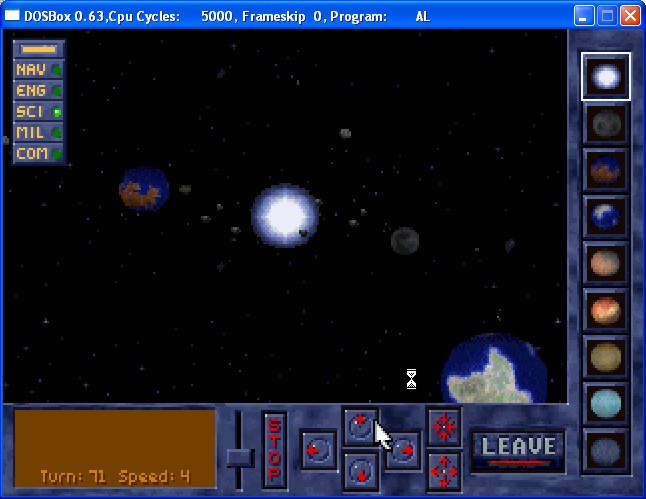 You even could simulate the whole thing (although I’ll admit that this would probably work better as part of its own standalone game), unlocking it when you hit that point on the tech tree. You could build O’Neill habitats at the Lagrange points, lunar colonies, and start to terraform Mars, while simulating the population growth and the trade routes (lunar solar power to Earth for funds, lunar oxygen to the space stations, super strong materials to Earth and the Moon, etc.) The colonies would have a more limited set of city improvements and could increase your civilization size total. The space colonies would "unlock" the research of more technologies (microgravity-produced materials and pharmaceutical products) and Wonders like space solar power systems that would give your terrestrial civilization definite advantages. The fancy 3-d globe view in Civilization IV could have been used to zoom out to see a view of the solar system and would allow you to click on various planets or points in space, which would bring up a more traditional Civilization world interface for each point, a lot like Sierra's classic "Alien Legacy" (like in the screenshot at left). Heck, you could even have an option for a “traditional” Civilization game, letting the luddites turn off all of this future tech and space stuff to keep them happy. There seems to me to be a lot of gaming potential here, and I while think it’s clear that a standalone Civilization in Space product would be an incredibly fun and rewarding experience to play with an amazing array of strategic choices, there certainly exists opportunities to add Future Tech and space development to a more traditional, terrestrially-centered Civilization game.
Unfortunately, none of this applies to Civilization IV. You can build a space elevator, but there's still no provision for Lunar or Martian colonies, asteroid mining, O'Neill colonies, space factories, or X-40 style orbital bombers in Civilization IV. Granted, if you have a space elevator, then all the rest of this stuff will happen in due course, which was probably in the back of the designer’s minds. Still, that's not as much fun as doing it yourself.
Although I understand that the designers wanted to keep things simple, I think that they really missed the boat on this one. There must be a fun way to add this “Longer Reach of History” content, including an expanded tech tree, a significant space settlement and development component, future weapons, and projected social trends to a terrestrially-centered Civilization game, without it being dull and tedious. Firaxis had a chance to create an epic and inspiring game about humanity's inevitable spread into the Universe that surrounds us, and they blew it. They're now going to get beaten to the punch by Spore, which already looks like it's going to be a very special game. I expect and hope that enterprising modders will start adding more future technology components, including space colonization, to the game now that the SDK is out.
A Mod World: The answer to the missing content and gameplay issues raised above is going to be the game's modability and extensibility. I’m a big fan of game mods; Mods for UT2004 have really expanded the longevity of that title, and in the case of Orbiter, for example, have dramatically added to its the content and usefulness. So, I am very happy that Civilization IV was built from the ground up to support modding and includes native support for XML and Python. Almost all aspects of the game can be changed. Now that the SDK has been formally released, I expect the quantity and quality of mods to dramatically increase. I also expect that many of my problems with the gameplay and content will eventually be rectified by mods. The best place to get mods, of course, is the Civilization Fanatics Forum Creation and Customization section, where there’s lots and lots of good stuff.
Modding is great, so why is it in this section? The reason is managing the mods is a real chore. The model for supporting fan-made mods is Microsoft Flight Simulator 2004. FS2004 has a really neat interface that let’s you add mods to the game, pick the ones you want to play with (you can pick as many as you want, and they’re persistent across gaming sessions), and tells you of potential conflicts if you’re running more than one, all from within the game. By contrast, much of the Civ IV modding is done by adding files in Windows Explorer and/or modifying text files, you can only run one mod at a time from within the game, and when you start a mod it requires a game restart. That’s annoying. If Civ IV was the first game that supported mods, I would go easy on it, but here in the 21st century, an FS2004-style mod management screen isn’t a luxury, it’s a necessity.
Bugs...lots of 'em: This brings me to the technical issues, which are the biggest single problem with this game. When the game first came out, I experienced repeated crashes and memory leaks. It was unplayable. The first patch helped things a little bit, but serious problems persisted for me until the 1.52 patch released Christmas Eve. Now, in a post-1.52 patch world, when game year 1900 comes along, I still start to experience severe memory leaks, video stutters, and hang-ups. Needless to say, it's massively annoying and frustrating, especially since with my build-gobs-of-infrastructure-then-smush-my-opponents-with-modern-armor style of play most of the action happens near the end of the game. I suspect that I would enjoy this game more if it didn't make me wait for 10-15 seconds before every unit movement or battle resolution. The typical answer to this problem on the forums seems to be “Buy more RAM,” which I suppose might be considered by some a valid solution. BUT, in my opinion, if you meet the minimum hardware requirements for a game, it should run just fine at a low or even medium graphical detail setting. You may have to turn off some eye-candy, but with all the settings dialed down it should run very smoothly in all situations. In my case, my machine easily exceeds the hardware settings listed on the Civilization IV box, and it still runs slower than molasses in February, even with all of the graphics settings dialed down to their minimum. I regard this as completely unacceptable. 2K/Firaxis actually had an extensive public beta for the game, which should have ironed out most if not all of the technical problem. Astonishingly, the beta test did not. I wish that Firaxis had been a little less aggressive with their hardware requirements, and had also tested the game on more laptops and low-end systems in order to iron out the kinks for those of us without liquid-cooled dual-core Falcon V Athlon FX-62 SLI RAID systems. Since the 1.09 patch pushed the onset of severe memory leaks back to the 1800s and the 1.52 patch pushed the leaks back to the 1900s I'm hoping that the 1.61 patch will push them into the 2000s. [UPDATE: Nope, memory leaks still there with the 1.61 patch...guess I'll see how the next patch does….]
Conclusion: If it sounds like I have conflicting opinions about Civilization IV, I do. I give the designers a lot of kudos for reevaluating the user experience from the ground up. I really can't blame them for not trying new things. There really is a lot to like in this game, including: The simplified new game interface, the ability to zoom out and see the whole planet, the new civics screen, the refined emphasis on culture and scientific research, the replacement of the pollution with the much more fun “health” metric, the return of wonder movies, religions, improved enemy AI, and extensive built-in mod support.
I really do like some of the design changes, but for every cool thing they put in, either they changed something that I liked or put in something I didn't like, including: The “and/or” tech tree, the snarky civilopedia, the useless advisor screens, the “Diplomatic Spreadsheet” that takes most the fun out of negotiations with AI players, the unrealistic nuclear weapons, the non-unique artwork for civilization units, guys with pointy sticks can still defeat B-2s, there's no throne room or palace, the on-orbit assembly version of the space race victory is still MIA, excessive hardware requirements, and it still has significant technical problems, even after three patches.
By most reasonable metrics, Civilization IV is a good and (mostly) fun game. Despite the preceding rants, I actually like it quite a bit. But I also strongly feel that it’s missing something. Civilization IV doesn't include features that I and other fans have been waiting for a long time to see, including better military management, dual production queues, a longer reach of history, an expanded tech tree, futuristic military units, undersea colonies, and space development. This complete lack of major new content is a severe shortcoming of the game. I think that Firaxis/2K really missed the conceptual boat by not turning outward and melding Civilization with Alpha Centauri, especially with Spore on the way. Instead, they turned inward, simplifying and narrowing the focus of the game, and in the process I feel that they stripped a lot of the game's personality and character away. In addition, I strongly feel that the move to a 3-d graphics engine, while having impressive results on high-end systems, unnecessarily imposed excessive hardware requirements on the 99.9% of us who don't have dual-core gaming powerhouse machines while causing a bevy of technical problems with the game--without actually improving the gameplay.
Is Civilization IV better than Civilization III? It's different, but not necessarily better. Is it better than Civilization II? Nope. Is it better than Alpha Centauri? Definitely not. Is it fun? Yes. Do I like Civilization IV? Yes, and I play it frequently, but I strongly feel that it's a few patches and several mods away from being the game that it could be. Is Civilization IV worth buying? Maybe. More than any other game I think I've ever played, my answer to the question “Should I buy Civilization IV?” would be “It depends”. If you are someone who has always been put off by the complexity of the Civilization series, now is your big chance to try it. If you loved Civ I, Civ II, and SMAC, Civ IV is different enough that you might be put off. In any case, you should download the demo and see if it works well with your hardware, as well as meshes with your individual tastes and expectations. You'll probably like it, but there's also a decent chance that you won't.
Be sure to also read Part 1 and Part 2 of this series, as well our story about a three day multiplayer Civilization IV match, Juliraptor's discussion about how to mod and patch Civilization IV, and her impressions of the game. Photo Credit: Civilization IV Fansite Kit/Firaxis.
Tags: Civilization IV
Sunday, May 28, 2006
An Epic Review of Civilization IV (Part 2)
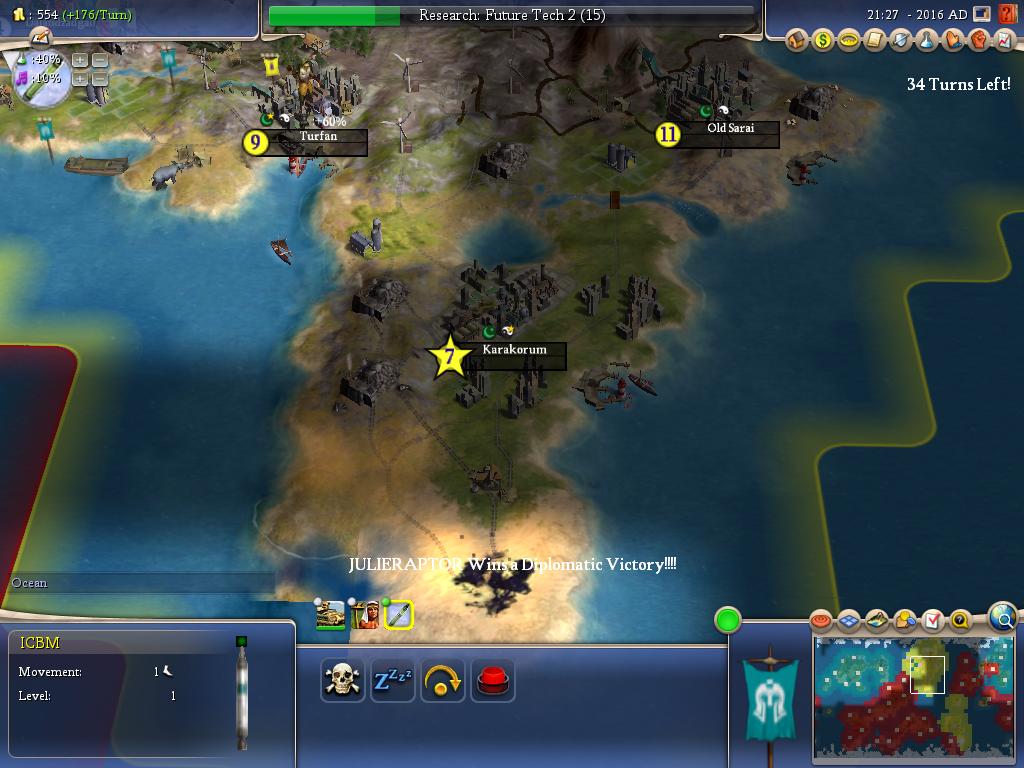
This review is so long (ironically, just like a game of Civ IV) that it has been broken up into several posts. This is Part 2. You can visit Part 1 here and Part 3 here.
The Game: The game opens with Leonard Nimoy narrating the same opening cards with the same music that opened the original Civilization several lifetimes ago. It's a really nice touch, especially for those of us who spent lots of time with the original game. Civilization IV is quite different from its predecessors. They did make a real effort to redefine the user experience by taking out many things that were annoying, such as pollution, but unfortunately they also put in some pretty annoying stuff (we'll get to that later). In general, I think that its safe to say that while Rise of Nations was an attempt to add Civilization to the RTS format, Civilization IV is an attempt to add RTS elements to Civilization. Civilization IV can be seen as a direct response to Rise of Nations, a valiant attempt to broaden the user base by simplifying the gameplay and adding some RTS-style elements.
Interface: The main game window where you'll spend most of your time has been cleaned up and simplified tremendously, and amplified with some snazzy (though excessively resource hogging) 3-d graphics. I really like the way that you can zoom all the way out to see your planet from space; that's a nifty feature (although they didn't take it to its logical conclusion...we'll pick up that rant in Part 3). Although I would rate the main game interface as “Vastly Improved” I would have to rate the advisor screens as “useless;” for whatever reason a lot of the functionality which was there previously is now gone, and it's really annoying. Again, it's a small thing, but I appreciated the concept of giving your advisors a face and a personality-it made things seem more real. That's all gone here; it's like I'm interacting with Lotus-1-2-3, with a lot less functionality, I might add. I'll call out the “Military Advisor” for an especially severe taunting, because they took out the ability to upgrade your units from the advisor screen. You now have to go and hunt down individual units in cities and upgrade them one by one, an incredibly taxing experience. The same story repeats itself throughout the city advisor screens: The functionality and personality from previous Civilization games is gone, replaced with a seemingly detailed spreadsheet that aren't really that useful. We'll put that down as an “I hope they fix it with the expansion pack” kind of deal. Fortunately, enterprising modders have already begun to tweak the advisor screens.
City Management: Improving city management has been one of the most commonly requested features for Civilization IV. This is one thing that Civ III tried to do, but didn't succeed at. Even though the support costs were still borne by a single civilization budget, you had to do a lot of twiddling in each city to control what your civ's production was--a dumb system. There was nothing more frustrating than the "Tenochtitlan can't support..." message. Well, city managment in Civilization IV is quite a different than that in Civ III. The "Governor" function has been discontinued in favor of some simple settings for each city--you can maximize production or research, for example. You can access most of the basic city functions directly from the main screen, without having to zoom into the city view. When you zoom into the city view, it is very similar to the traditional Civilization city management screen (although you can no longer see a picture of what your city looks like; you now see the city and all of the Wonders in the main 3-d view).
Did they cut down on the twiddling? Well, mostly. You no longer have to mess with adding entertainers and physicians to the mix to keep your citizens happy; cities no longer riot (all though they do become unhappy, which lowers production) and instead of pollution, there's now a health metric; industrial cities will be significantly less healthy than smaller cities, which can lead to unhappiness and a decline in production. That's all well and good. However, the unit production is still rather twiddle intensive. Although there is a fairly easy way to have global unit production queues, the cities are different enough that you have to go to each one separately and adjust production. There's no point in having an outlying outpost of the Empire spending 50 turns building a warrior, after all. I was actually very surprised that they chose not to implement the system from Galactic Civilizations, where each colony has dual "social" and "military" production queues, allowing you to both mobilize and improve your civilization. That is one of the real strengths of GalCiv. That's a lot more realistic than the way it's presented in Civilization. In real life, for example, Detroit is not only the automotive and industrial automation capital of the world, but all U.S. military tanks are produced there as well. I'll go ahead and place my vote for dual production queues in Civilization V right now!
Intelligence: One of the things I appreciated about previous games was their emphasis on setting up a quality Foreign Service and Intelligence networks, including embassies; for the most part, that has been deemphasized in this game. Many of the functions of the spies have actually been taken over by the priests and temples. The spy unit in Civilization IV is primarily used for the recon of enemy territory.
Diplomacy: The AI in the game is definitely improved over Civilization III; you can now peacefully coexist with at least some of your neighbors, GalCiv style. However, although at first I appreciated the Spreadsheet-like list of your negative and positive attributes in the eyes of the foreign leader that you're talking to, now I'm not a big fan. It makes things too easy; you now know exactly where you stand with everyone without any of the ambiguity that characterizes real-world diplomatic interactions. Despite all the glitzy 3-d avatars for the civilization leaders, they feel much less real to me than the faction leaders in SMAC--Instead, I feel like I'm fighting Microsoft Excel. Plus, inexplicably, you cannot issue demands to the AI any longer. In the old games you could ring up the AI and demand tribute or cities, often outrageously, but now the game selects what you can demand for you. Basically, I felt that you are now limited to simply reacting to your opponents. I rarely issued ultimatums in previous games but now that I can't I really miss this feature.
Conflict and Battles: Many of the interviews and pre-release hype focused on how they were revamping and improving the military unit management. Let's face it: Civilization is a war game. Conflict is a HUGE part of how you play the game. Unfortunately, the Civilization games (SMAC included) have never really managed the command and control of military units very well. When you have a large military, especially at the end of the game, it's very difficult to control. So, I was hoping that Civilization IV would have something better, perhaps like the original Harpoon's interface for combat, where you could assemble task forces, use combined arms, and move them about as independent units. Y'know, the basic type of commands and abilities that a real leader of a civilization would have, especially with modern C3I (command, control, communications, intelligence) systems. However, they kind of came up short when it came to military unit management. It's still basically the same; the vaunted “RTS-style military management” doesn't in practice work very well. Yes, you can select lots of military units at once, but they don't move in unison unless they're all one unit type. When you move a combined-arms military force, it still meanders along in a very confused fashion. Back to the drawing boards, folks. Still, I'll give them credit: The took the cursed Great Leaders from Civilization III out of the game, and replaced them with much more fun Great Persons. Yay! I really hated how I would never generate any Great Leaders but the AI opponents would come after me with dozens of armies. That small change alone really improved my gameplay experience. In general, though, the way that the military units themselves are handled is an improvement over the previous games, largely because the “guy-with-a-pointed-stick-defeats-M1Abrams-Tank” kinds of battles are now far more infrequent (though, frustratingly, they still happen).
Not MAD Enough: One thing that I'll call out for a severe taunting: the way the game handles nuclear weapons. In Civilization II, you had almost the full range of strategic deterrent options: you had tactical nuclear missiles, ICBMs, and you could store nuclear missiles on submarines, to have SSBN deterrent patrols. Nuclear weapons had devastating consequences, and could truly be destabilizing. If the AI announced they had one, the tension level rose dramatically. Rise of Nations also handles nuclear weapons well. It doesn't let you do the SSBN thing, but the utter devastation wrought by the nuclear weapons is quite realistic, and the Armageddon timer keeps things from going out of hand while still permitting tactical nuclear releases. In Civilization II, Caesar especially was prone to not only announcing his control of nuclear weapons, but actually releasing them. In one case in Civilization II, having pushed Caesar into a corner with conventional arms, he promptly and unexpectedly decimated Washington and New York. I promptly retaliated using my SSBNs, which were sitting undetected off the Roman coast—an unwanted, though realistic, nuclear exchange. I really don't like the way that nuclear weapons are handled in Civilization IV. Only one kind of nuclear weapon is allowed, and you can't put nuclear weapons on submarines. Plus, despite the hysterical response of the AI players if you actually initiate a nuclear release, they really aren't that powerful; they just do a little damage to all the units in a city, and the city itself is only marginally affected. I'm a peaceful guy, and I'm certainly not advocating the wanton use of nuclear weapons, but if you have to use them, then they should have powerful effects as well as consequences. In Civilization IV, the political effects of using nuclear weapons are overly excessive and the physical effects are far too weak.
Without Vision, the People Perish: I greatly appreciated how completely essential a healthy R & D budget is to final victory in Civilization IV. If you don't spend on basic R & D, your civilization whithers and dies. Say what you like about the current President, between the Vision for Space Exploration and the American Competitiveness Initiative he's done an excellent job of correcting a decades-long trend and increasing funding for core American engineering/physical science R & D activities—NSF funding tripled, NASA going back to the Moon and on to Mars. So, I thought that was a nice touch on the part of the game designers. I also liked how your R & D investment played into the Culture ranking. What I didn't like was that the orderly technological progression from previous games has been deleted. I can see why they did this, but in my view it doesn't work very well. Hopefully, a future mod (or expansion) will give us traditionalists the ability to turn on a Civilization I-III style tech tree.
Culture War: Paradoxically, although Culture is now a bigger part of the game, I felt that it was harder to wage Culture War on your neighbors in Civilization IV than in Civilization III—enemy cities seem to rebel to your side much more infrequently. I did like the addition of culture specific Wonders like Broadway, and how the culture rating now ties into the city happiness index.
Religions: Speaking of culture, the biggest new addition in Civilization IV is the much-ballyhooed and somewhat controversial Religion feature. I actually like the new Religion feature in the game; it really doesn't distract from the gameplay (although it can also be argued that it doesn't really add that much, either) and was tastefully done in such a way that, objectively speaking, no one really has any right to be offended, flame wars on the forums notwithstanding. I especially liked how you don't have to actively use the Religions if you don't want to, a nice touch. I've heard some suggestions that each religion should have had one unique attribute; I agree, and that could be a good thing for an expansion pack. Another good ideas that I've seen on the forums that could improve this part of the game is have some sort of “Inquistor” unit to go and sweep competing religions out of your cities. My biggest beef with the Civilization IV religion component is that, being a pragmatic type, I tend to research stuff like “Iron Working” and “Horseback Riding” before Mysticism and thus I'm almost always beaten to getting a state religion. In that scenario, the best thing is to get the Free Religion civic ASAP.
Victory: The victory conditions remain essentially unchanged from previous games, although a new “Culture Victory” has been added (if you have three cities above a certain culture rating; essentially, you have to build all the Wonders in a few spots). The emasculation of the Space Race Victory continues; it's now even more simplified than it was in even Civilization III. I heartily disagree with this design decision. The endgame race to the stars was one of the best parts about Civs I and II! Civilization I and II featured realistic on-orbit assembly of the ship in space, which could only be stopped by capturing your capital. This really ratcheted up the tension level, making for some memorable late game strategies. In Civilization IV, you just launch a rocket and you win! Gone is the marvelous endgame tension, along with any sense of astronautical engineering reality, as you decide whether you have the time to build a fully equipped starship with a maximum chance of survival or whether you have to launch a bare-bones ship to beat the competition.
Edutainment: Many of the early patches focused on fixing the Civilopedia, giving it the web-like interface and hyperlinks. As usual, you can easily spend a lot of time browsing the Civilopedia (which infuriates folks in multiplayer games, by the way....) and learning a lot about human history. However, as a student of history, I'm forced to point out that the Civilopedia in Civilization IV (unlike the previous games) is written in a far less objective, far snarkier style. Now, I don't want to sound stuck-up, and it is just a game, and we shouldn't take ourselves too seriously, but the Civilization series and the Civilopedia in particular has always been a great way to get young folks to learn about world history in a fun matter, almost despite themselves. For that reason, the informative, objective, and dispassionate Encyclopedia entries from the previous titles (and even the Datalinks entries from SMAC) were really great learning tools. To be blunt, the Civilization IV civilopedia gets it flat-out wrong in a couple of cases, most notably in the Apollo and space elevator entries. A little less snark and a bit more Britannica would have been greatly appreciated.
Government and Social Choices: The civics and government choices have been heavily revamped. I thought that the way that previous games had handled governments and social choices was just fine, and really didn't need any tweaking. In Civilization IV, instead of simply picking a government type, you now have a wide array of sociopolitical options. This is the one area where they did build on the SMAC experience: they were trying to blend the Civilization III style government selection with the SMAC social engineering tab, and for the most part it works.
Monuments: Inexplicably, the “Build-a-palace” screen has been taken out of the game. I really liked the palace feature; I was glad to see it back in Civilization III (Civilization II had a “Throne Room,” which wasn't nearly as much fun). I saw an interview with some of the designers where they essentially said “Oops” about this feature, so maybe we'll see the triumphant return of the palace builder with the expansion pack.
Multiplayer: The multiplayer component of the game has been significantly improved over Civilization III. Or, to put it another way, unlike Civilization III, Civilization IV's multiplayer game actually works. Connecting through firewalls remains problematic, but Civilization IV seems to work very well with the Hamachi program, and is significantly more stable in multiplayer mode than Civilization III.
In Part III, we'll conclude this series of articles by discussing the cool features we wanted that weren't in Civilization IV. Be sure to also read Part I of this series, as well our story about a three day multiplayer Civilization IV match, Juliraptor's discussion about how to mod and patch Civilization IV, and her impressions of the game. Photo Credit: Me!
Tags: Civilization IV
Subscribe to:
Posts (Atom)


 Posts
Posts

