
One of the Civilization IV mods that I've been most interested in seeing has finally emerged--a Tech Tree Mod! I've been really looking forward to twiddling extensively with the tech tree. This should be interesting! One wonders if this could be a way for more Future Tech type technology, like solar power satellites and lunar Helium-3 mining. Congrats to TheLopez, the enterprising coder who put this together. The next item on the SRV wishlist is the Alpha Centauri mod, the development of which appears to have unfortunately stalled.
Tuesday, November 21, 2006


Tuesday, November 07, 2006
I was excited about Star Trek Legacy, until...
...I saw the hardware requirements. Bethesda has released the official PC hardware requirements for Star Trek Legacy, and as I feared they're awfully darn steep. This is unfortunate, because the initial set of requirements that had been posted on Amazon.com were quite reasonable. This is a lousy decision on Bethesda's part, because it immediately puts the PC version of the game out of reach for most consumers (myself included). This kind of "hardware creep" is one of my pet peeves, not only because it's aggravating to me personally (I was really excited about Legacy prior to finding this out; now I've canceled my pre-order) but because it's the biggest single reason why consumers have been steadily leaving the PC as a gaming platform. I've never been even remotely interested in consoles, but I must admit that in recent years the increasing capability of console platforms (especially the Xbox 360) has made me actually consider switching over to some sort of console. Until manufacturers realize that 99.99% of us can't afford to buy new systems every three months, PC gaming will continue to decline.
Monday, October 30, 2006
Orbiter 2006: It's not just for fun...
Last week, a group of NASA and industry engineers began a grassroots campaign for a new lunar architecture to supersede the NASA Ares I/V system that is currently being developed. To my admittedly untrained eyes, this new plan seems sensible and worthy of consideration. However, I wouldn't be mentioning this here at SRV unless I had noticed something very nifty in the photos section of the DIRECT website: These folks used Orbiter to do some of the spiffy strategic visualizations of their concept! That's pretty cool. It not only says a lot about how the proliferation of powerful personal computers are letting smaller groups do things that could previously only be done by government or large businesses, but it also says a lot about the fundamental usefulness of easily extensible software platforms like Orbiter.
Monday, October 09, 2006
Star Trek Turns 40
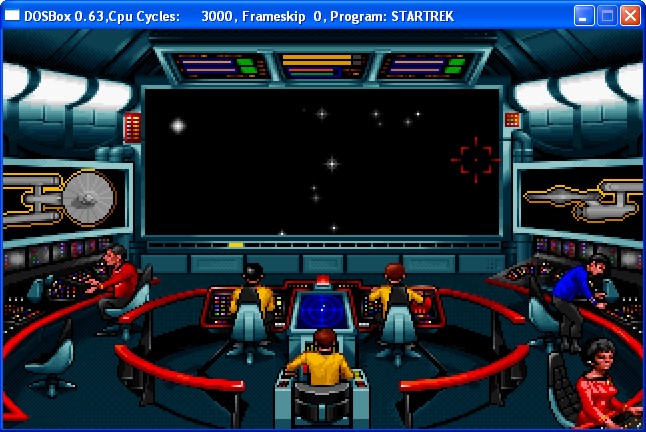 A few weeks ago, Star Trek celebrated its 40th Anniversary with a whimper, not a bang, although the surprise release of the long-overdue Star Trek Remastered was welcome news. Good thing that Star Trek Legacy is coming out soon, and it's actually looking quite promising if the recent CGW feature article is any indication. The designers continue to say all the right things, the screencaps look great, and grouping all five Star Trek incarnations with a D.C. Fontana-penned (writer of the famed TOS episode "Journey to Babel," as well as the Bridge Commander storyline) story could turn out pretty well. I've officially upgraded my status from "guardedly optimistic" to "cautiously hopeful." Although I'm on record as thinking that a new Star Trek single player RPG or adventure game should be made ASAP, when you throw in the possibility of getting to command your own crew in Star Trek Online, things just might be looking up in the world of Star Trek computer games. Although I'm worried that Legacy might not run on my little Inspiron, I'm a lot more excited about Legacy than I am about Star Trek XI. In fact, I think that the best Star Trek for the forseeable future is in all likelihood going to exist in computer game form. Why, you ask?
Since Enterprise was canceled and Nemesis failed at the box office, there's been all kinds of stories about what Star Trek needs in order to come back. This ignores a simple point: People won't spend time or pay money to watch awful stuff, even if it says Star Trek in the title. A prequel show actually could have been great, but Enterprise-as-aired was just a terrible show: The writing was horrible, none of the characters were memorable, the acting was wooden, and the series didn't just flaunt the established continuity, it barfed all over it. It wasn't until the fourth season that the show started to tell the kinds of respectful and interesting stories that the fans had been expecting, but by then nobody cared. I personally gave up on the show halfway through the second season. Now that I've seen some of the fourth season shows in syndication, I think that the show would still be on the air if it had started telling those stories right off the bat. Quality fourth season episodes nothwithstanding, Enterprise was sufficiently horrible that a "retcon" is in order, and I hope that future Trek producers will decide to ignore that it was ever produced (just like what happened to the Star Trek Animated Series).
The immediate cause of Nemesis failing was that it came out the week before The Two Towers. But the real reason was that like most films in the Internet era, the shooting script had leaked several months beforehand and it was pretty obvious that this movie was just a lame TNG version of The Wrath of Khan, so many fans choose to save their money and stay home. One of the problems that I had with it (besides the gaping plot holes and logic errors) was that the death of Data was was quite contrived and unnecessary from a dramatic standpoint. Mainly, though, my biggest problem with Nemesis was that it was the fourth TNG movie but still had the same friggin' plot as the first three: overblown villian vs. Our Heroes. Bah. This is Star Trek, not James Bond. The critics reached similar conclusions and really pounded Nemesis, which, combined with the LOTR thing, is probably why most casual Star Trek fans stayed home. I'm a big TNG fan so I went to see it anyway, despite my misgivings, largely because I'd seen every ST movie in a theater and didn't want to break the streak.
I read most of the reviews of the movie, and it was pretty obvious that (repetitive plotline aside) the critics had also gotten just as tired of the whole Star Trek concept; I remember one reviewer called Star Trek's characteristic optimism "grating" and others called the notion of space travel "silly". This is an important point that is utterly lost on many Star Trek fans : A society that doesn't find the idea of people exploring space to be inherently awesome will not find a show about people exploring space remotely interesting. Surprisingly, many modern Star Trek fans have forgotten this and couldn't care less about the real-world exploration of space; they care more about the character interaction and philosophy and so forth [Don't believe me? Head over to a Star Trek forum and you'll see a disturbingly high number of "the space program is a waste of money" posts. The irony is lost on them....]. It was the Apollo landings and the development of the Shuttle (and all of the hopes that went with it) that fueled the 1970s popularity of Star Trek (and, for that matter, Star Wars and Close Encounters). I think that it is telling that at the height of it's popularity (circa 1986 to 1992-ish) the Shuttles were flying regularly, we were on our way to the Moon and Mars, and Space Station Freedom was going to be finished by 1997. There was a lot more general excitement about our future in space. I think it's safe to conclude that if Star Trek is ever going to be as popular as it was even fifteen years ago, then society is going to have to be reprimed to acknowledge that human space development really is exciting and important. To that end, the best possible thing for Star Trek fans to do to "save" the show is to simply start doing their part by a) actually paying attention to what NASA and ESA and Energia and NewSpace companies are doing here in real life and b) writing letters supporting space exploration to Congress and newspapers, instead of starting useless "save-our-show" letter writing campaigns. Besides this obvious and important point, what other lessons can we learn from recent Star Trek?
- It's about exploration, stupid. It's right up there in the opening credits, the most famous split infinitive in history and the phrase which really ought to be the NASA motto: "To boldly go where no man has gone before." Even TNG did very little boldly going. If you're on a starship exploring, then you should actually go find exciting stuff at frequent intervals. The last two movies have featured diplomatic negotiation as key plot points. Y-a-w-n. It can be done, and done well: Exhibit A is Stargate SG-1 and Stargate Atlantis, any episode of which features more adventure and fun than any Star Trek produced in the 21st century. If you aren't floored by the innate coolness of what you're seeing you're not going to want to come back.
- Continuity is not a problem. People stopped watching Enterprise in large part because it flat-out barfed on the established continuity. We're not talking about little dippy Nitpicker errors, either. I couldn't care less if in one episode the Enterprise can only go at warp 4.9 and in the next one, it's charging at warp 5.5. Bah. That's small-time. We're talking about big, gaping, monstrous problems: Emotional lying kung-fu Vulcans, a "primitive" starship that looks just like a TNG starship, first contact with the Klingons not causing a war, a heretofore unmentioned Xindi attack, and TNG stuff like holodecks, Borg, and photon torpedoes popping up in Season One. Would it really have been that hard to take a few minutes and look this stuff up in the Star Trek Encyclopedia? I didn't think so. Would the stories on Enterprise have suffered any from doing so? Well, they couldn't have gotten any worse, that's for sure.
- Villians are overrated. Yes, The Wrath of Khan is everyone's favorite ST movie (except mine! I'm partial to The Motion Picture), and it happens to involve a larger-than-life villian with a powerful device that could be used as a weapon. Unfortunately, it has established a pattern that has proven almost impossible to escape. This plot device of a scenery-chewing villian who gets a Big Gun and threatens universal peace has now been the key story point of 8 of the 10 Star Trek movies, and it's completely worn out it's welcome. I think that it's quite telling that the absolute, hands down most popular ST movie is The Voyage Home, which made a tremendous amount of money and was a resounding popular and critical success (launching TNG in the process)--all without a scenery chewing villian.
- It's gotta be fun. Star Trek at its best has a certain joie de vivre: it should be an optimistic, hopeful, and interesting adventure. Seeing the Enterprise in the first movie? Fun. The battle in the Mutara Nebula? Fun. The Voyage Home? Fun. Worf bounding through infinite parallel universes? Fun. Sisko and company visiting the original ship? Fun. Voyager almost getting home? Not fun. Overblown villian threating Earth with a particle-of-the week gun killing Data for no reason? Not fun. Watching Captain Archer meander his way through a tepid, poorly written, ill-conceived episode? Not, by any definition, fun.
- You have to see the Enterprise. The Enterprise got really short shrift in the last four movies. All we got to see of the cool new ship was the bridge and a few lame rooms (the ship's library? who wants to see that, and why would you need one aboard a starship, anyway--don't they have Google Book Search in the future?). It wasn't any different or cooler than the things you ever saw on the series.
- It's gotta be cool. The interior design of the ship in the Enterprise show was lousy, too: cramped, dank, and decidedly non-futuristic. I wouldn't want to be on that ship unless I had a big flashlight. Here in real life, the International Space Station has been designed to be open and airy to improve morale and prevent cluaustrophobia. The new ship has to be clean, bright and futuristic-looking if you want your audience to believe that you're in the future. This is one of the big problems with Battlestar Galactica: Everything on that show, even the big ship that can go faster-than-light, looks exactly like present-day stuff, which, frankly, is pretty distracting.
- Quit reversing the polarity already. From about the 6th season of TNG on, the answer to nearly every problem has been reversing the polarity on some kind of subatomic particle. They never did that on the old series and things worked out fine. They tried really hard not to do this on Enterprise, but they just couldn't help themselves. Plus, it really wouldn't hurt to talk to a real scientist or engineer occasionally. Enterprise had some aneyurism-inducing scientific blunders.
- Grit hurts your teeth. Ever since the success of Battlestar Galactica, I've heard a lot about how ST needs to be "gritty". They tried to make Enterprise gritty, and it was just annoying. Sweaty folks yelling at each other is not the only ingredient behind successful entertainment.
- No Time for Time Travel. Ahh, the most overused plot device in Star Trek. Unfortunately, this one has some pedigree, because the old guys did it on the Original Series and again in The Voyage Home, with great success. Unfortunately, since that point time travel has been a major part of two more ST movies and countless episodes, and a ludicrous "Temporal Cold War" that culminated in goofy space Nazis was a big part of Enterprise. A completely mediocre Voyager episode-which I never saw, because I quit watching Voyager early on due to excessive lameness--even suggested that Starfleet would be flying "timeships" through the timeline by the 29th century. Enough already. Again, I point to the opening credits: "Space, the final frontier...." If we wanted to watch a show about time travel we'd watch Dr. Who.
In general, my overarching conclusion is that the "problem" with Star Trek stems more from a general lack of creativity and attention to detail, coupled with a society that does not currently value the adventure and breathtaking promise of space, and not from any inherent flaw with the concept or the established continuity.
So, having already said too much, what do I think about the eleventh movie? I think that a Battlestar Galactica-style reboot is a perfectly awful idea no matter how you look at it. The new BSG works well because the old BSG show had certain flaws, a small audience, and was only aired for one season, so there was nowhere to go but up. Star Trek, which has a rich 40-year history and has inspired billions of people, is another story. There's simply no reason why a movie that builds on all previous Star Trek which has come before can't be a huge commercial success; cherry-picking a few elements and disregarding the rest wouldn't really be Star Trek any longer. I'm also not a big fan of going back to the TOS era with new actors, especially with the TNG folks still around wanting to do more. Recasting the TOS actors was tried after Star Trek V and bombed horribly; the idea was a complete non-starter with the fans, so they made the successful Star Trek VI instead. On the other hand, the fan-produced New Voyages series is surprisingly good. Although I'm skeptical, I am forced to admit that a new TOS story with skilled younger actors in the Kirk, Spock, and McCoy roles (especially if Shatner and Nimoy appeared in a framing story), which didn't barf on the established canon, might work in principle if handled respectfully with the greatest of care. But since one the most credible rumors of the moment has Ben Affleck playing a young Captain Kirk, I feel safe concluding that for years to come, the best and most entertaining Star Trek is going to be played on PCs around the world. Star Trek was actually the basis of the first real computer game ever made; it is only fitting that computer games like Star Trek Legacy and Star Trek Online are carrying the torch of modern Trek.
Be sure to also read BNGPossum's earlier take on his favorite Star Trek computer games.
Tuesday, October 03, 2006
The First Orbiter 2006 Patch Is Out

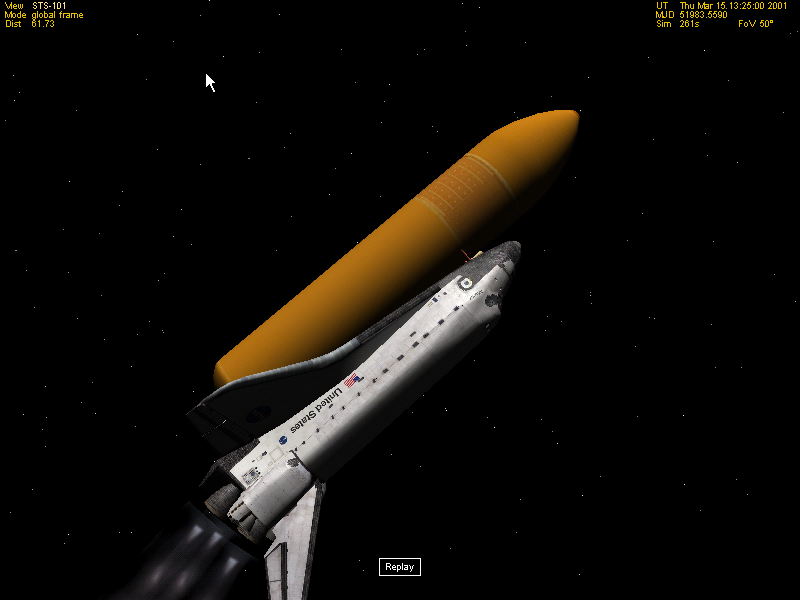
From Music of the Spheres comes news about the first patch for Orbiter 2006, which as usual includes a bunch of under-the-hood improvements and a spiffy new 3-d cockpit for the Space Shuttles. If you haven't downloaded the newest version and taken Orbiter for a test flight, now would be a great time.
Friday, September 29, 2006
The Real Star Control III: Update
Some recent news on the Star Control front. First, the long-overdue news: the soon-to-be-departed Computer Gaming World finally inducted Star Control II into its Hall of Fame. Talk about sneaking one in at the last minute. It's 14 years late, but better late than never, I guess.
Second, the incomparable Pages of Now and Forever brings news from Toys for Bob, the current home of famous Star Control developers Fred Ford and Paul Reiche. Apparently, they have received approximately 3000 messages supporting a new sequel to Star Control II after their initial plea for support earlier this year, and they still want a new PC version of Star Control to be their next game.
There's still time sign the petition supporting a new Star Control here, show your support by emailing Toys for Bob at the address here, and of course play the best PC game ever made yourself by downloading the open-source Star Control II release The Ur-Quan Masters by from here.
Second, the incomparable Pages of Now and Forever brings news from Toys for Bob, the current home of famous Star Control developers Fred Ford and Paul Reiche. Apparently, they have received approximately 3000 messages supporting a new sequel to Star Control II after their initial plea for support earlier this year, and they still want a new PC version of Star Control to be their next game.
There's still time sign the petition supporting a new Star Control here, show your support by emailing Toys for Bob at the address here, and of course play the best PC game ever made yourself by downloading the open-source Star Control II release The Ur-Quan Masters by from here.
Friday, September 22, 2006
The Great Linux Experiment
 I've been buried under a blizzard of paperwork and a dense overlapping tangle of immobile deadlines over the past few months. Haven't had much time for gaming, but you can't keep a Techno-Nerd Master down for long. Being an adventurous sort, I recently volunteered to be a Linux "Guinea Pig," meaning that I joined the Linux conversion pilot program at my place of business, and in the process evaluated several different versions of Linux. Why subject myself to the annoyance of switching operating systems, you ask? Well, for starters, I was mightily impressed with the Ubuntu partition I played around with earlier this year on my little Inspiron (That hard drive space has since been claimed by SWAT 4...more on that soon...). However, the big reason is that I've had a *lot* of problems with Windows XP: Boot sector problems, device driver conflicts, file association errors, slow restarts, firewall clogging, slow startups--you name a problem, and I've had it. Although I've always been a Microsoft user and in general like their products, I just have to say that Windows XP has been an awful computing experience. It's not like I'm manually editing the registry (although I've had to do that to correct problems...) or reconfiguring the hardware interrupts or overclocking or have a hard drive stuffed with viruses. WinRot is much more pervasive in XP, and it's just too darn easy for an average user doing average things to just destroy Windows XP to the point where you have to reformat and reinstall the operating system. Repeatedly. After the great annoyance of my last reformat a few months ago, I'm open to alternatives, at least for productivity tasks at work (you just can't replace Windows for gaming, so no home boxes yet). The capabilities of modern Linux environments are comparable to Windows systems, and the stability of Linux, especially when compared to a system beset with WinRot, is very appealing.
As part of the process, I was able to try several Linux distributions. I first tried the universally liked OpenSUSE 10.1. I sure was impressed by the nifty graphical installer, but it didn't actually work with my work computer, a vanilla Dell PC, circa 2002. For whatever reason the desktop environment wouldn't display on my monitor, and since answers weren't forthcoming quickly from the forums, I decided to stop twiddling with OpenSUSE and try something else.
I then set up Fedora Core 5, which was a vast improvement. I was tremendously impressed with the robust Fedora Core 5 distribution, and I would easily recommend it to someone seeking to try a version of Linux. Unfortunately, I couldn't get some software packages that I need to work with FC5, despite much twiddling.
At this point, setting up a Linux partition was beginning to seem like a whole lot more trouble than it was worth. I had been favorably impressed with Ubuntu Linux earlier this year, so I decided to give it another try for my work partition. Plus, Ubuntu recently released it's new 6.06 version, so I was eager to see what had been improved. The new Ubuntu 6.06 graphical setup screen was actually in my view a significant step backwards in terms of ease-of-use and capability from the Ubuntu 5.1 text-based setup, and wasn't nearly as easy to use as the OpenSUSE or FC5 setups. That's one of the significant Ubuntu 6.06 drawbacks, especially for a Linux newbie such as myself. On the other hand, once I had set up my partition space (thanks in no small part to the experience I gained setting up OpenSUSE and FC5; I doubt I would have been successful otherwise), the actual configuration of my desktop and the installation of the software packages that I need took about 20 minutes, and I was up and being productive shortly thereafter! A far cry from the time consuming hardware and software difficulties that I had encountered with OpenSUSE and FC5, which propelled Ubuntu 6.06 to victory in this particular contest. The precompiled Debian packages that you can access through the Ubuntu repositories are truly great, especially if you don't have the time to mess around with installing software. You can get more Ubuntu packages more conveniently and more quickly through the Ubuntu repositories than you can with either OpenSUSE and FC5. This ease-of-use is probably Ubuntu's greatest strength.
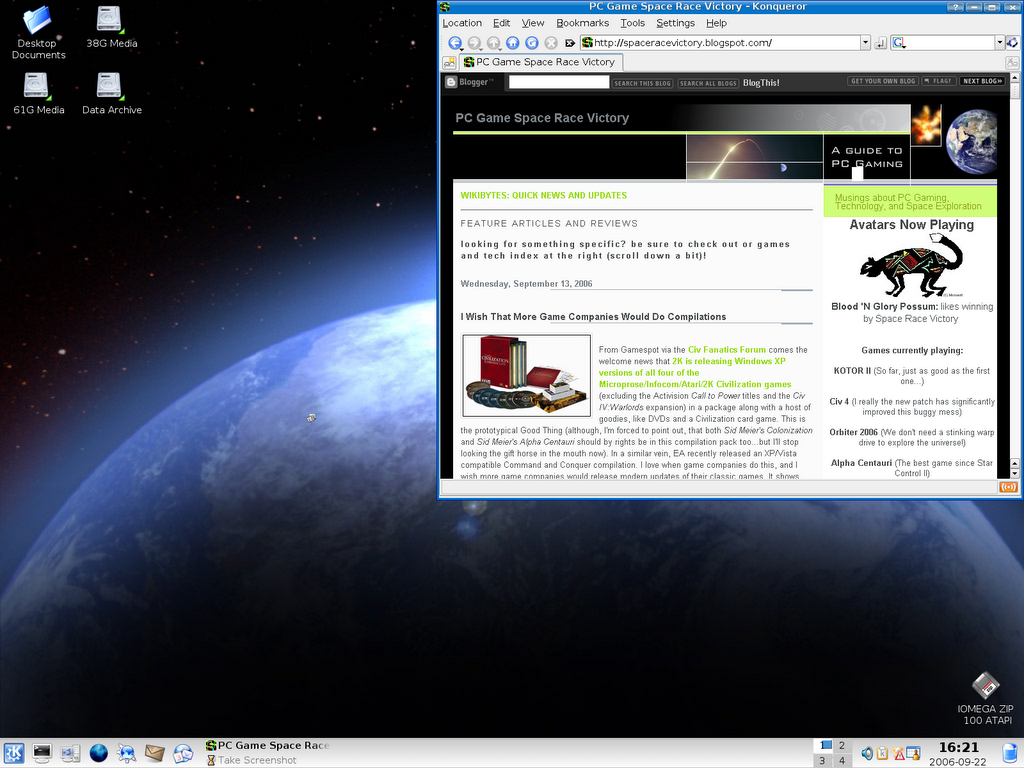 I then had to decide between the KDE (Kubuntu, pictured at left) and the GNOME (Ubuntu) desktops. Each one has its strong points; however, despite the fact that I appreciated the greater control and more options offered by the KDE desktop, I find that it is easier to get work done in the GNOME environment. I'll give KDE another shot in the future, but for right now I'm using a highly customized GNOME environment and liking it immensely. As I pointed out in my original Ubuntu review, I feel that the GNOME environment has significant advantages over the standard Windows environment.
 I've been running the Ubuntu partition for almost two months now, and in general the experiment has been a success. Once you get it working, Ubuntu 6.06 is amazingly stable and the GNOME environment is really pleasant to use. I can create, open, and send PDF files; OpenOffice lets me open and edit MSOffice files easily without any problems so far; GIMP works fine for image processing tasks, and some of the more important customized software packages that I need have worked fine in Linux so far. Firefox has also proven its worth once again; its platform-neutrality coupled with the power of Google Browser Sync and Google Notebook (more on those later, too...) has significantly reduced the browser twiddle quotient. Ditto for Thunderbird, which remains my favorite e-mail client. Ubuntu 6.06 sports Thunderbird 1.5, a vast improvement over the Thunderbird 1.06 testing build that was available for the last Ubuntu version.
Having gone onto the record about how much I like it, I'll now go ahead and highlight a few of my bigger Ubuntu/Linux pet peeves from the perspective of a lifelong Windows user after a few months of constant use (no, that's not cliche at all...):
1) Hardware Support, Pt. I: It turned out to be relatively easy to set up Ubuntu to listen to most of the common audio and video formats, so that wasn't a problem. However, for whatever reason, the sound card drivers for my card don't work very well in Linux, although they work just fine for Windows XP. Whenever I try to listen to anything involving audio, the audio quality is terrible-it sounds like I'm listening through a waterfall with a front-end loader running in the background. Some more work there is definitely needed. I know it's sound-card specific to my machine because the Ubuntu partition on my laptop never had any problems at all with audio or video playback.
2) Evolution seems like a fine little e-mail client, but it's darn hard to configure properly. It also has a lot of trouble, for whatever reason, with our in-house email network (odd, because our email server is Linux-based). Kontact in KDE doesn't seem to have these problems, either. Fortunately, it's relatively easy to set up Thunderbird in Ubuntu, and I can use Firefox to access my Google Calendar, so I don't really need Evolution's functionality at the moment.
3) For any program not already in the Ubuntu repositories, installing it and setting it up is generally a real hassle. This was true with the other distributions that I tried. This is also where the only Linux system crashes that I've had thus far have occurred. Clearly, a better way of setting up new software is needed, especially to pull in the newbie contingent. The kinds of problems that I had would send a less-experienced user fleeing to the hills.
4) Both FC5 and OpenSUSE have fancy GRUB partition-selection frontends that easily handle the Windows XP partition if it exists, but Ubuntu 6.06 still has the text UI for the GRUB frontend, which is far less user friendly. The Ubuntu folks really, really need to fix this.
5) Legacy hardware support, Pt. II: I have a Radeon 7500 in my work desktop, which works just fine in Windows XP as a 3d platform using DirectX. The Linux 3-d picture is significantly murkier. Although Nvidia's Linux support is apparently pretty good, ATI's Linux support is terrible, and their drivers for Linux as provided in the Ubuntu distribution simply won't work with the 7500. This means software rendering aplenty, and for any application requiring 3-d acceleration I have to go back to Windows. [Update: ATI is apparently deleting all pre-9200 cards from its “official” Linux support]. This means that I have been unable to try out the vaunted Ubuntu 6.06 eye-candy.
6) This isn't really anyone's fault, just an observation: The ability to run just a few Windows applications in Linux would greatly reduce the occurrences of me having to shift back to Windows. Try as I might, however, I just can't get the open-source Wine emulator to work. I'll keep working on that, though. Some method of that would let me reliably run Windows applications—not a lot of applications, just a few-- in Linux would be an immensely handy thing.
The hardware problems are the most aggravating of this particular set of problems, and will probably require the manufacturers to get more firmly onto the Linux bandwagon. The audio problem is annoying, for sure, but the lack of support for my Radeon card (the 7500 isn't that old, after all) is a serious issue.
Because there's some software packages that I require for work that aren't yet available for Linux, it's not a wholesale switchover and I'm going to maintain a Windows XP partition on my workstation that I switch back to on a regular basis. However, I've been genuinely surprised by how infrequently I've had to switch back to Windows. I generally only need to switch back about once a day, although I've gone for an entire week without having to switch back. I only switch over to Windows when it would be more efficient to work in Windows (meaning that the software I need doesn't work in Linux or equivalents aren't available). The fact that I can do so much using nothing but Linux applications is certainly impressive.
The hardware problems are the most aggravating of this particular set of problems, and will probably require the manufacturers to get more firmly onto the Linux bandwagon. The audio problem is annoying, for sure, but the lack of support for my Radeon card (the 7500 isn't that old, after all) is a serious issue.
Because there's some software packages that I require for work that aren't yet available for Linux, it's not a wholesale switchover and I'm going to maintain a Windows XP partition on my workstation that I switch back to on a regular basis. However, I've been genuinely surprised by how infrequently I've had to switch back to Windows. I generally only need to switch back about once a day, although I've gone for an entire week without having to switch back. I only switch over to Windows when it would be more efficient to work in Windows (meaning that the software I need doesn't work in Linux or equivalents aren't available). The fact that I can do so much using nothing but Linux applications is certainly impressive.
Subscribe to:
Posts (Atom)


 Posts
Posts

