PC Gaming, Technology, Planets, and Whatever We Feel Like

Search This Blog

Showing posts with label Planets. Show all posts

Monday, August 16, 2010

More Awesomeness from LROC

More awesomeness from the Moon! NASA's LROC (Lunar Reconnaissance Orbiter Camera) recently released this mosaic of Orientale Basin, a huge impact basin on the Moon that is 930 km across! The central floor is flooded with basaltic lava flows and so are some of the rings.

Image Credit: NASA/GSFC/Arizona State University

Read Full Article here: http://lroc.sese.asu.edu/news/index.php?/archives/247-Orientale-Basin.html

Saturday, August 14, 2010

Volcano on the Moon

Shown here is part of a Lunar Reconnaissance Orbiter Camera image (NASA/GSFC/Arizona State University) of what are probably two small volcanoes on the Moon. The volcanoes are only ~1.5km in diameter each.

Read full article here: http://lroc.sese.asu.edu/news/index.php?/archives/262-Volcanoes-in-Lacus-Mortis.html#extended

Thursday, August 12, 2010

A Mantle of Ice on Mars?

This image from HiRISE shows a "mantled" terrain where features of the landscape appear subdued. This might be due to a surface layer of water and carbon dioxide ice that varies seasonally or with changes in Mars' orbit.

Image credit: NASA/JPL/University of Arizona

link to original article here: http://www.uahirise.org/PSP_002917_2175
Tuesday, August 10, 2010

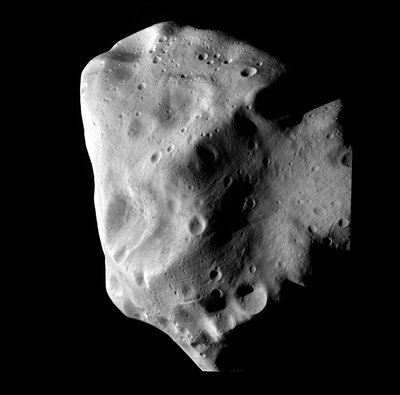
A Bit of Asteroid Candy

Perhaps old news now, but well worth a second (or first) look: 

Asteroid Lutetia at Closest approach.


Image Credits: ESA 2010 MPS for OSIRIS Team MPS/UPD/LAM/IAA/RSSD/INTA/UPM/DASP/IDA

Link to original ESA article here: http://www.esa.int/esaCP/SEM44DZOFBG_index_0.html

Sunday, August 08, 2010

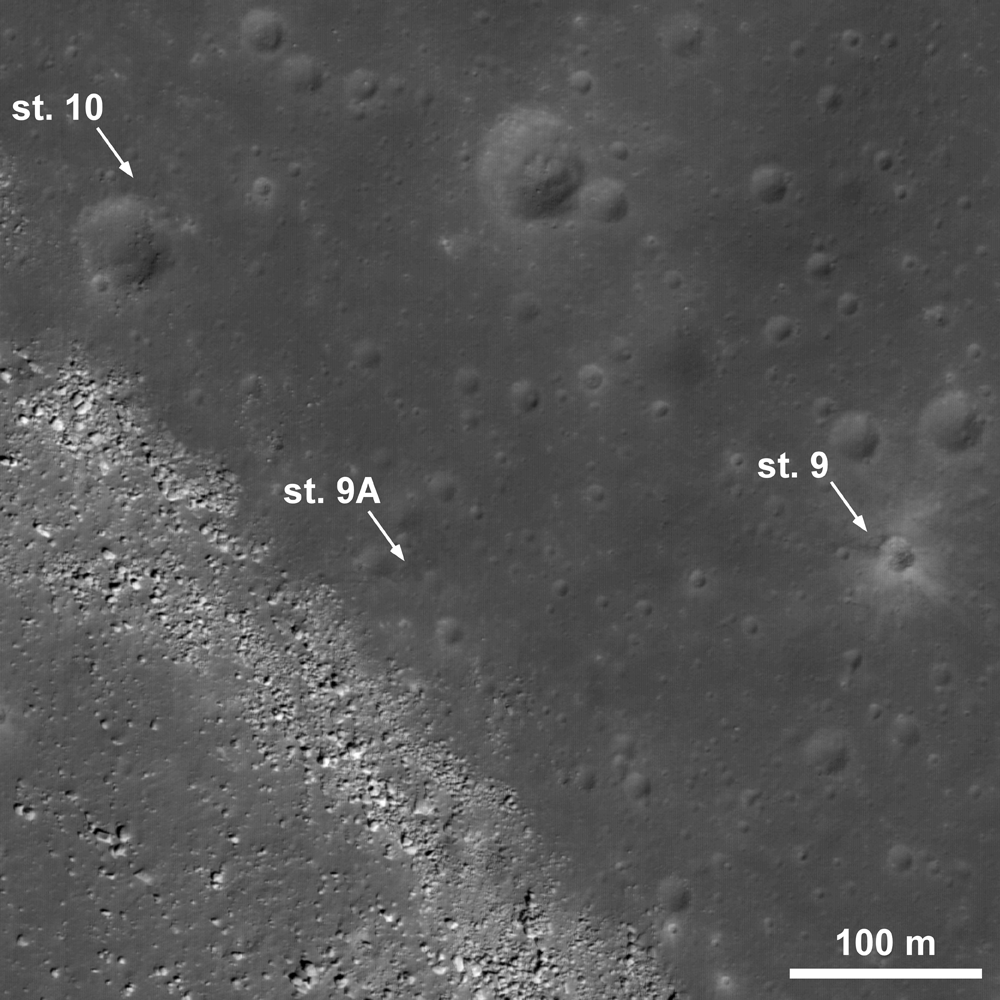
New crater on the Moon

The Lunar Reconnaissance Orbiter Camera team recently released this figure showing a new crater on the Moon the formed sometime in the last 38 years. They know it's that young because the crater wasn't there when Apollo 15 flew over the same location in 1971!

Image credit: NASA/GSFC/Arizona State University

Link to original article here: http://lroc.sese.asu.edu/news/index.php?/archives/260-New-Impact-Crater-on-the-Moon!.html

Monday, August 02, 2010

Changes in methane lakes on Titan

A recent article in the New York Times highlighted that during the four years Cassini has been at Saturn, the level of liquid in the methane lakes of the southern hemisphere of Titan have dropped. The methane lakes were originally detected by radar instruments onboard the spacecraft. Because Cassini has had a unique opportunity to study the planet and it's moons over time, the changes can be linked to seasons on Titan.

Image credit: NASA/JPL/Caltech

Full article here: http://www.nytimes.com/2010/07/27/science/space/27titan.html?_r=2

Wednesday, June 02, 2010

Herschel Crater on Mimas of Saturn: Needs Pink Spice Geysers

Check out this Astronomy Photo of the Day:

Herschel Crater on Mimas of Saturn

Q: Why is this giant crater on Mimas oddly colored?
A: Because the outer solar system is a fascinating place! Could use some pink spice geysers though.


Sunday, May 30, 2010

Amazing sand dunes on Mars

It's a Mars-filled weekend here at SRV. Check out this amazing HiRISE image of a sand dune inside a crater on Mars.
This image also appeared in a Discover Magazine online article: http://blogs.discovermagazine.com/badastronomy/2010/05/05/are-martian-gullies-formed-by-water-or-not/

Image Credit: NASA/JPL/University of Arizona. Full Image at: http://hirise.lpl.arizona.edu/PSP_001440_1255

Saturday, May 29, 2010

Martian polygons

This HiRISE image shows polygonal ridges that may have originally been dunes. How they formed is still unknown. Link to full image: http://www.uahirise.org/ESP_017348_1910

Image Credit: NASA/JPL/University of Arizona.

Wednesday, May 19, 2010

Martian glaciers

This image from the HiRISE camera in orbit around Mars shows features on Mars that suggest the material has flowed as in terrestrial glaciers. The glacier is covered by dust and debris and looks darker than glaciers on Earth.

Image credit: NASA/JPL/University of Arizona
Link to full image: http://www.uahirise.org/ESP_017024_2230

Wednesday, May 05, 2010

Martian Megabreccia

This is a new image of Mars showing the central part of a large impact crater on the surface. It has a rock texture called 'megabreccia' because the rock clasts are bigger than in normal breccias, which are formed when impacts break up the surface rocks. This type of rock had never been seen before HiRISE observed it. For a more technical description read the whole feature by the HiRISE camera team:  http://www.uahirise.org/ESP_017257_2360


Image credit: NASA/JPL/University of Arizona.

I just love all the new discoveries coming from all the current spacecraft on and around the planets and moons, it's so amazing that objects people have been observing for hundreds to thousands of years can still hold surprises! Who knows what we could find if we look even closer?!

Monday, April 26, 2010

Retracing the Steps of Apollo 15

From the Lunar Reconnaissance Orbiter Camera: follow link to read full article.

Retracing the Steps of Apollo 15: Constellation Region of Interest

In this image you can see where astronauts (and the lunar rover) disturbed the lunar surface on Apollo 15 at Hadley Rille.

Image credit: [NASA/GSFC/Arizona State University].

Thursday, April 22, 2010

Ash and Lightning Above an Icelandic Volcano

Another Astronomy Picture of the Day link:

Ash and Lightning Above an Icelandic Volcano

Why did the


A pretty pheonominal photo worth an extra click to view.

Saturn's Moons Dione and Titan from Cassini

Astronomy photo of the day link:

Saturn's Moons Dione and Titan from Cassini

What would it be like to see a sky with many moons?


Q. What would it be like to see a sky with many moons?

A. Totally awesome, it'd be like playing Spore, but I'd still want my terraforming tools :)

Wednesday, April 21, 2010

Tuesday, April 20, 2010

Springtime Avalanches on Mars

Springtime dust avalanches on Mars caught in action with the HiRISE camera.

Image credit: NASA/JPL/University of Arizona.

Original Posting: Springtime For Avalanches

Monday, April 19, 2010

Space potato

Just for fun, a link to the Astronomy Picture of the Day from April 5:

Prometheus Remastered

What does Saturn's shepherd moon Prometheus really look like?


Q: What does Saturn's shepherd moon Prometheus really look like?

A: It looks a lot like a giant, grey space potato. But still, a very dramatic pose.

Thursday, April 15, 2010

Venus hotspot

Hotspots on Venus detected with the Visible and Infrared Thermal Imaging Spectrometer on Venus Express may be active volcanoes. This would be a first for the terrestrial planets in the inner Solar System besides Earth.

Image credit: NASA/JPL

Wednesday, April 14, 2010

Funny Face Craters on Mars

Not very scientific, but here are some Mars emoticons. Image taken with the HiRISE camera. The smiley and frowny features are explained as dunes on the floors of the craters.

Image credit: NASA/JPL/University of Arizona, more info at: http://www.uahirise.org/ESP_017020_1620

Tuesday, April 13, 2010

Saturn's PacMan

The so-nicknamed PacMan on Saturn's moon Mimas imaged with Cassini is just temperature variations over the surface possibly due to different surface materials.


Image credit: NASA/JPL/GSFC/SWRI/SSI