
Civ V weekend has finally come (...and gone!)
Here are my initial thoughts on the game:
1) It took some time to adjust to the new interface, but overall the game-play is more straightforward and most of the annoying things, like Spies and Religions, are gone. The new "Policies" format was fun, it was more like a mini tech tree, or like RPG-style "leveling up" for your civ.
2) Many user-configurable features have been removed: such as the option to have single-character units, how to handle multiplayer dropouts, in-game clock in multiplayer, and other small tweaks that I enjoyed.
3) I like the new ability to see a small Wonder "info-graphic" upon completion of wonders in the mulitplayer game.
4) I also enjoyed the new City States, which provide your civ many benefits like culture or free units.
5) In mulitplayer, the animations of your units are disabled so they just jump from tile to tile. This was kind of disappointing; I hope they bring the animations back in a future patch.
6) There were some bugs. For example, the City State stautus is buggy and sometimes it will say they are angry even though you just friend-ed them.
7) Some "features" of the interface were frustrating: for example, the active unit will change after doing an action, but focus remains on the old one. I kept accidentally moving units that were offscreen to the wrong places and couldn't easily find them.
8) Another frustrating feature of multiplayer is that the game doesn't let you do things between multiplayer turns. It seems like it may only queue one action between turns, and I found myself repeatedly commanding units or cities to do something, only to find nothing was happening. In a mulitplayer game, it's nice to queue things between turns while waiting for others to finish.
I have yet to finish a game, but Civ V looks promising. In the meantime, I'm hoping for a patch to tweak the small game-play deficiencies.
Showing posts with label Reviews. Show all posts
Showing posts with label Reviews. Show all posts
Tuesday, September 28, 2010


Thursday, September 09, 2010
A Timely Review of Sins of a Solar Empire: Trinity
Or: Forget Everything You Thought You Knew About Strategy Gaming And Learn to Define Victory For Yourself
A Joint Review by Blood N' Glory Possum and Jraptor
 Since Galactic Civilizations II doesn’t have a proper multiplayer module, we’ve been hunting for a good 4X sci-fi-themed space empire game. We bought the original Sins of a Solar Empire a while ago when it got phenomenal reviews, hoping that it would fill the multiplayer 4X void. At the time, we thought that the original Sins had lots of potential, but found the whole pirate aspect tedious (unlike, for example, the Antarans in Master of Orion II). We recently gave Sins of a Solar Empire: Trinity an extensive “test drive” because it offers some gameplay improvements over the original game (like fortifications), as well as the ability to disable the pirates. Our comments here cover the Entrenchment game and not the Diplomacy add-on because we were never able to get that to load in multiplayer mode.
During install and multiplayer set up we encountered a surprising number of bugs, considering the maturity of this product (it has, after all, been on the market for some time). During install, three links are created for each of the three different versions of the game; however, only one of them actually worked. If you do manage to directly load each version of the game, you will have to reset the video and sound settings on the first load of each version. Fortunately, you can switch between versions of the game from the in-game menu; it basically closes and reloads the game into the selected mode. But at least this way, your video and sound settings are preserved.
When we tried to enter the multiplayer waiting room, we encountered errors about our game versions not matching even though we both had the latest updates. Checking the file system, one of us had an additional file in one directory. The only thing we can think of to explain this is one of us had installed the original Sins and then the Trinity add-on while the other only installed a virgin copy of the Trinity pack. It seems odd to us, however, that this should cause such an extreme error that could have been quietly resolved if the game merely synced our files. We were, ultimately, able to resolve the problem for the Entrenchment game by uninstalling the version that had the original Sins upgraded to Trinity and replacing it with a fresh install of just the Trinity pack. However, the Diplomacy game still gave us a “files don’t match” error and declined to let us play.
From the beginning, it was not obvious that the only way to win Sins: Trinity is through domination. No where in the game manual does it say how you actually “win” the game. We have divined from internet searches that the way to win is through total obliteration of all other factions. We also gather from internet searches that more win modes were added in for the “Diplomacy” expansion. However, since we were never able to win the game (or load the Diplomacy expansion), we still don’t really know. We suspect others have had the same problem since some websites suggested that “winning is how you define it for yourself.”
Overall, the gameplay was good. Managing the planets is simple when “auto-placement” is turned on. However, this will severely weaken your defenses because the algorithm that the game uses to place them is not at all good. It will lump them all together, or place them on the opposite side of the planet from where enemies would be expected to arrive. To the credit of the game creators, the manual doesn’t say that “auto-placement” will do desirable things.
We tried many strategies during gameplay that usually work in other strategy games. However, after 3 days and several restarts, we were, in the end, always completely overwhelmed by hundreds of enemy AI ships. The AI is aggressive and in our opinion unreasonably difficult even when on “Easy” mode. While we aren’t looking for a free lunch, we found this to seriously limit our enjoyment after 72 hours.
 In particular, we found that the Vasari were vastly more powerful than either the TEC or the Advent. To test this theory, we played one game with only Vasari factions, figuring this would put us all on the same level playing field. We found that we did better this way, and our ships would occasionally survive a battle (as the TEC and Advent, our ships had an annoying tendency to explode after only a few seconds in combat). However, we were still completely unable to match the fleet production of the AI teams, and for hours we watched them produce 1 ship every 30 seconds, forming huge fleets of hundreds of ships. It’s possible that our game was so unbalanced because the Pirates were disabled; however, the game should be able to compensate for this.
As we lost planets, we also lost the ability to use the higher level technologies we had researched because we started loosing the labs needed to conduct and maintain high level research. So, as you get pushed back, you are put at an even further disadvantage, one that makes it impossible to recover -- your faction will effectively revert to a more primitive technological state in addition to the loss of economy as planets fall to the enemy. This severely limits the quality and quantity of ships you can produce and your ability to fend off attackers.
As soon as the AI smells weakness, it is relentless in your destruction. First, it will break all deals with you, then it will ignore your pleas for mercy, and finally it will taunt you as you’re crushed under the wheels of destruction. We tried the game on “Normal” mode first and then on “Easy”; in both cases we saw little difference in the game’s actual difficulty level. The AI in both modes still out-performed us economically and fleet-wise.
In general, we are big fans of Stardock; they treat their customers really well. The trend continues with Sins. We really appreciated how Stardock allows at 2 LAN players per copy of the game, which is great for multiplayer gaming on a home network. Sins also has truly reasonable system requirements - it can even run on a netbook! Unfortunately, this is not the game for you if you’re looking for a quick victory or any measurable victory at all; it lacks the perfect design balance of (for example) Rise of Nations. This game is designed to be difficult and is horribly unforgiving of even the tiniest mistake. The uncanny AI will know all your moves and move against you before you can recover. Think it won’t notice that you’ve moved your fleet to another planet for a few turns? Think again. Think those last 50 enemy ships you destroyed was the best they could do? Nope, wrong again. They’ll be sending a “little surprise for you” very soon, oh and they’ll taunt you about it, too.
The bottom line is that we’re still waiting for a great modern multiplayer sci-fi 4X game to build on what Galactic Civilizations II accomplished. Sins has a lot of good ideas, but it really doesn’t come together to make a compelling multiplayer experience.
A Joint Review by Blood N' Glory Possum and Jraptor

During install and multiplayer set up we encountered a surprising number of bugs, considering the maturity of this product (it has, after all, been on the market for some time). During install, three links are created for each of the three different versions of the game; however, only one of them actually worked. If you do manage to directly load each version of the game, you will have to reset the video and sound settings on the first load of each version. Fortunately, you can switch between versions of the game from the in-game menu; it basically closes and reloads the game into the selected mode. But at least this way, your video and sound settings are preserved.
When we tried to enter the multiplayer waiting room, we encountered errors about our game versions not matching even though we both had the latest updates. Checking the file system, one of us had an additional file in one directory. The only thing we can think of to explain this is one of us had installed the original Sins and then the Trinity add-on while the other only installed a virgin copy of the Trinity pack. It seems odd to us, however, that this should cause such an extreme error that could have been quietly resolved if the game merely synced our files. We were, ultimately, able to resolve the problem for the Entrenchment game by uninstalling the version that had the original Sins upgraded to Trinity and replacing it with a fresh install of just the Trinity pack. However, the Diplomacy game still gave us a “files don’t match” error and declined to let us play.
From the beginning, it was not obvious that the only way to win Sins: Trinity is through domination. No where in the game manual does it say how you actually “win” the game. We have divined from internet searches that the way to win is through total obliteration of all other factions. We also gather from internet searches that more win modes were added in for the “Diplomacy” expansion. However, since we were never able to win the game (or load the Diplomacy expansion), we still don’t really know. We suspect others have had the same problem since some websites suggested that “winning is how you define it for yourself.”
Overall, the gameplay was good. Managing the planets is simple when “auto-placement” is turned on. However, this will severely weaken your defenses because the algorithm that the game uses to place them is not at all good. It will lump them all together, or place them on the opposite side of the planet from where enemies would be expected to arrive. To the credit of the game creators, the manual doesn’t say that “auto-placement” will do desirable things.
We tried many strategies during gameplay that usually work in other strategy games. However, after 3 days and several restarts, we were, in the end, always completely overwhelmed by hundreds of enemy AI ships. The AI is aggressive and in our opinion unreasonably difficult even when on “Easy” mode. While we aren’t looking for a free lunch, we found this to seriously limit our enjoyment after 72 hours.
 In particular, we found that the Vasari were vastly more powerful than either the TEC or the Advent. To test this theory, we played one game with only Vasari factions, figuring this would put us all on the same level playing field. We found that we did better this way, and our ships would occasionally survive a battle (as the TEC and Advent, our ships had an annoying tendency to explode after only a few seconds in combat). However, we were still completely unable to match the fleet production of the AI teams, and for hours we watched them produce 1 ship every 30 seconds, forming huge fleets of hundreds of ships. It’s possible that our game was so unbalanced because the Pirates were disabled; however, the game should be able to compensate for this.
 As we lost planets, we also lost the ability to use the higher level technologies we had researched because we started loosing the labs needed to conduct and maintain high level research. So, as you get pushed back, you are put at an even further disadvantage, one that makes it impossible to recover -- your faction will effectively revert to a more primitive technological state in addition to the loss of economy as planets fall to the enemy. This severely limits the quality and quantity of ships you can produce and your ability to fend off attackers.
As soon as the AI smells weakness, it is relentless in your destruction. First, it will break all deals with you, then it will ignore your pleas for mercy, and finally it will taunt you as you’re crushed under the wheels of destruction. We tried the game on “Normal” mode first and then on “Easy”; in both cases we saw little difference in the game’s actual difficulty level. The AI in both modes still out-performed us economically and fleet-wise.
In general, we are big fans of Stardock; they treat their customers really well. The trend continues with Sins. We really appreciated how Stardock allows at 2 LAN players per copy of the game, which is great for multiplayer gaming on a home network. Sins also has truly reasonable system requirements - it can even run on a netbook! Unfortunately, this is not the game for you if you’re looking for a quick victory or any measurable victory at all; it lacks the perfect design balance of (for example) Rise of Nations. This game is designed to be difficult and is horribly unforgiving of even the tiniest mistake. The uncanny AI will know all your moves and move against you before you can recover. Think it won’t notice that you’ve moved your fleet to another planet for a few turns? Think again. Think those last 50 enemy ships you destroyed was the best they could do? Nope, wrong again. They’ll be sending a “little surprise for you” very soon, oh and they’ll taunt you about it, too.
The bottom line is that we’re still waiting for a great modern multiplayer sci-fi 4X game to build on what Galactic Civilizations II accomplished. Sins has a lot of good ideas, but it really doesn’t come together to make a compelling multiplayer experience.
Sunday, August 22, 2010
Giving up on Colonization

So, I was hoping that Civ IV: Colonization would be a much-needed return to form for Firaxis. Unfortunately, this plot below accurately sums up my experience playing the Colonization remake:

...and then the wheels fall off. This game has an insane amount of micromanagement. You have to manually adjust all of your colonists, and the population grows at a snail's pace. The economy of your settlements almost never gets going. Equipping and building military units is a tedious chore, and when the Revolution happens (if it happens at all, since Liberty Bells aren't that easy to make, either), the Royal Expeditionary Force is so large that it is impossible to beat - and this is on Chieftain mode!
Now, I'm usually the first person to stand up and say that complexity is not a bad thing. After all, Flight Simulator is one of my favorite games and in real life, colonizing the New World wasn't exactly a picnic. However, Civ IV: Colonization is just annoying and tedious. What a shame - the original game is a timeless classic, but new one just isn't as fun as the original. Unless I get really bored at some point in the future (which isn't likely, since I'm barely 1/8 of the way through Dragon Age: Origins and I have an unopened copy of Sins of a Solar Empire waiting in the wings) I probably won't ever try to play the Colonization remake again. I really hope that this isn't a preview to what Civ V is going to be like! I guess we will all find out on September 21st...
Tuesday, June 15, 2010
Defcon: Victory via Destruction
Defcon: The game where you will use nukes and lots of 'em.
You get 2 points for every person killed and only -1 points for every person lost.
Overall a fun way to spend an hour with no unpleasant guilty aftertaste.
It takes a while to get used to how to control your units (I'm still not sure I have that figured out) and to figure out what each one does. The game does come with a manual, which is full of handy information and bonus tips on how to "survive" an actual nuclear attack. You know, just in case the computer doesn't think it's a game anymore ;)
While playing a 2-on-2 game, we discovered that Europe can kick some serious butt against Asia. Moscow and Leningrad didn't even know what hit 'em in the first strike. This screenshot shows the total destruction of Russia. Eastern Asia hung on until the end mainly because it takes a long time to get all the way around the top of Russia, and I couldn't get there before the victory timer expired. In this Old World, 2 team match (humans v. AI), Europe was easily most defensible continent with 67.8 million kills and 0 loses. 'Nuff said.

You get 2 points for every person killed and only -1 points for every person lost.
Overall a fun way to spend an hour with no unpleasant guilty aftertaste.
It takes a while to get used to how to control your units (I'm still not sure I have that figured out) and to figure out what each one does. The game does come with a manual, which is full of handy information and bonus tips on how to "survive" an actual nuclear attack. You know, just in case the computer doesn't think it's a game anymore ;)
While playing a 2-on-2 game, we discovered that Europe can kick some serious butt against Asia. Moscow and Leningrad didn't even know what hit 'em in the first strike. This screenshot shows the total destruction of Russia. Eastern Asia hung on until the end mainly because it takes a long time to get all the way around the top of Russia, and I couldn't get there before the victory timer expired. In this Old World, 2 team match (humans v. AI), Europe was easily most defensible continent with 67.8 million kills and 0 loses. 'Nuff said.

Saturday, May 08, 2010
Go buy Mass Effect 2. Now.
Back in ye olden ty mes, there were certain game companies that when they released a new game, I would just buy it without waiting a few months for the reviews in Computer Gaming World. MicroProse was one of these developers, along with Origin, LucasArts, and Sierra, too. With the Mass Effect series of games, BioWare has now joined their august ranks. Mass Effect is that good. Sure, regular readers of SRV know that I think that Knights of the Old Republic was, in addition to being the best Star Wars experience since the Timothy Zahn novels of the early 1990s, the best computer game since Sid Meier's Alpha Centauri, and easily the best computer game of the 2000s. But, as good as KOTOR was, it might have been a fluke. I had never paid attention to RPGs at all before, but KOTOR got me interested, pretty much singlehandedly. However, KOTOR was using someone else's IP, and an IP that had been decimated by the recent movies, at that. Plus, BioWare didn't develop the sequel, which was developed in a hurry and felt a little rushed. So, I thought that KOTOR might have been a fluke.
It wasn't a fluke. Go buy Mass Effect 2 right now. In fact, while you're at it, buy the original Mass Effect if you haven't already and start playing it as soon as you can.
The graphics are outstanding; the digital “acting” in particular (with the exception of the Illusive Man in ME2, who looks like a demented Muppet) is unparalleled. These are the most “cinematic” games since the Wing Commander games. The gameplay has tactical and strategic depth without overwhelming the player. The “interrupt” system for conversations is one of the most innovative things I've encountered in a RPG of this type. Tired of talking? Use a Renegade interrupt to just shoot the guy. Awesome.
 Although I had actually bought the original Mass Effect in 2008, I didn't actually play it until late last year and I didn't finish it until last month. So, I got to finish the original ME, then import my Shepard character almost immediately into ME2. Bringing not just the character, but that character's decisions, and then making you live with them throughout the sequel, was a brilliant move by BioWare and the most innovative thing about the sequel. Not only does it really bring you into the story, but it has also made me want to go back to the original again after I finish playing ME2 for the first time and change some of the decisions that I made in order to see what would happen. That's just about the best and most entertaining way to increase the replayability of a game that I've seen, well, since the original Wing Commander's branching storyline.
Speaking of storyline: The Mass Effect universe is easily the best science fiction universe in gaming right now. These games are the best science fiction storytelling of the past ten years. The story is gripping – it really sucks you in like a good book. BioWare clearly put an extraordinary amount of time into producing this fully-realized universe populated by interesting (and in some cases, decidedly nonhuman) aliens. In all fairness, some of the ideas and themes you see in Mass Effect aren't terribly original. David Brin's Uplift books, in particular, which feature the plucky human heroes against a universe populated with an array of truly nonhuman aliens, appear to have been a major inspiration for BioWare (and are explicitly referenced by some of the characters). But, BioWare did an extraordinarily good job of putting all of the parts together, and it feels right. It hasn't been this much fun or interesting to explore the galaxy since Star Control II. In fact, the Mass Effect games are probably the closest thing we'll ever get to proper sequels to the first two Star Control games, although the ME universe lacks the zany humor of Star Control and is much more dark than the Star Control universe. That is actually pretty surprising, considering that the Earth in Star Control II got brutally subjugated and the whole point of Star Control II was preventing a genocide. But, I digress. The storyline of the Mass Effect games is incredibly compelling – it's pretty obvious that they sat down before the first game and really diagrammed the whole thing out, and the game is much better for it.
 It wouldn't be an SRV review without the quibbles about ME2—very minor, in this case. The original game was much more plausible from a gameplay standpoint; I really liked the regenerating guns (with depleting health being the major game mechanic), and I think that the whole “thermal clip” thing in ME2 feels a little forced (the cover-based shooter mechanics, on the other hand, are fun). I like the concept of surveying planets, but the implementation gets tiresome rather quickly. Most importantly, I also appear to be the only person on the planet who really, really enjoyed driving the MAKO around on the alien worlds in the first game. Driving the MAKO was itself fun, but it was also a completely believable way to explore a planet. Well, they took the MAKO completely out in ME2, and I really miss the driving when I'm planetside – the “Hammerhead” expansion pack, while fun, just isn't the same. Finally, in some of the cutscenes, we see human characters exposed to vacuum for prolonged periods with nothing but breathing masks – d'oh! But these are minor quibbles indeed.
What BioWare has done with the Mass Effect games is absolutely incredible. I haven't had this much fun with a computer game in a very long time. I haven't even finished ME2 yet, but I can hardly wait to play it through it again – and pre-order Mass Effect 3.
 mes, there were certain game companies that when they released a new game, I would just buy it without waiting a few months for the reviews in Computer Gaming World. MicroProse was one of these developers, along with Origin, LucasArts, and Sierra, too. With the Mass Effect series of games, BioWare has now joined their august ranks. Mass Effect is that good. Sure, regular readers of SRV know that I think that Knights of the Old Republic was, in addition to being the best Star Wars experience since the Timothy Zahn novels of the early 1990s, the best computer game since Sid Meier's Alpha Centauri, and easily the best computer game of the 2000s. But, as good as KOTOR was, it might have been a fluke. I had never paid attention to RPGs at all before, but KOTOR got me interested, pretty much singlehandedly. However, KOTOR was using someone else's IP, and an IP that had been decimated by the recent movies, at that. Plus, BioWare didn't develop the sequel, which was developed in a hurry and felt a little rushed. So, I thought that KOTOR might have been a fluke.
It wasn't a fluke. Go buy Mass Effect 2 right now. In fact, while you're at it, buy the original Mass Effect if you haven't already and start playing it as soon as you can.
The graphics are outstanding; the digital “acting” in particular (with the exception of the Illusive Man in ME2, who looks like a demented Muppet) is unparalleled. These are the most “cinematic” games since the Wing Commander games. The gameplay has tactical and strategic depth without overwhelming the player. The “interrupt” system for conversations is one of the most innovative things I've encountered in a RPG of this type. Tired of talking? Use a Renegade interrupt to just shoot the guy. Awesome.
 Although I had actually bought the original Mass Effect in 2008, I didn't actually play it until late last year and I didn't finish it until last month. So, I got to finish the original ME, then import my Shepard character almost immediately into ME2. Bringing not just the character, but that character's decisions, and then making you live with them throughout the sequel, was a brilliant move by BioWare and the most innovative thing about the sequel. Not only does it really bring you into the story, but it has also made me want to go back to the original again after I finish playing ME2 for the first time and change some of the decisions that I made in order to see what would happen. That's just about the best and most entertaining way to increase the replayability of a game that I've seen, well, since the original Wing Commander's branching storyline.
Speaking of storyline: The Mass Effect universe is easily the best science fiction universe in gaming right now. These games are the best science fiction storytelling of the past ten years. The story is gripping – it really sucks you in like a good book. BioWare clearly put an extraordinary amount of time into producing this fully-realized universe populated by interesting (and in some cases, decidedly nonhuman) aliens. In all fairness, some of the ideas and themes you see in Mass Effect aren't terribly original. David Brin's Uplift books, in particular, which feature the plucky human heroes against a universe populated with an array of truly nonhuman aliens, appear to have been a major inspiration for BioWare (and are explicitly referenced by some of the characters). But, BioWare did an extraordinarily good job of putting all of the parts together, and it feels right. It hasn't been this much fun or interesting to explore the galaxy since Star Control II. In fact, the Mass Effect games are probably the closest thing we'll ever get to proper sequels to the first two Star Control games, although the ME universe lacks the zany humor of Star Control and is much more dark than the Star Control universe. That is actually pretty surprising, considering that the Earth in Star Control II got brutally subjugated and the whole point of Star Control II was preventing a genocide. But, I digress. The storyline of the Mass Effect games is incredibly compelling – it's pretty obvious that they sat down before the first game and really diagrammed the whole thing out, and the game is much better for it.
 It wouldn't be an SRV review without the quibbles about ME2—very minor, in this case. The original game was much more plausible from a gameplay standpoint; I really liked the regenerating guns (with depleting health being the major game mechanic), and I think that the whole “thermal clip” thing in ME2 feels a little forced (the cover-based shooter mechanics, on the other hand, are fun). I like the concept of surveying planets, but the implementation gets tiresome rather quickly. Most importantly, I also appear to be the only person on the planet who really, really enjoyed driving the MAKO around on the alien worlds in the first game. Driving the MAKO was itself fun, but it was also a completely believable way to explore a planet. Well, they took the MAKO completely out in ME2, and I really miss the driving when I'm planetside – the “Hammerhead” expansion pack, while fun, just isn't the same. Finally, in some of the cutscenes, we see human characters exposed to vacuum for prolonged periods with nothing but breathing masks – d'oh! But these are minor quibbles indeed.
What BioWare has done with the Mass Effect games is absolutely incredible. I haven't had this much fun with a computer game in a very long time. I haven't even finished ME2 yet, but I can hardly wait to play it through it again – and pre-order Mass Effect 3.
Tuesday, February 06, 2007
A Timely Review of SWAT 4
I've never been a big fan of first-person shooters. I thought that Wolfenstein 3-D was pretty cool, but when the original Doom came out and garnered a whole bunch of critical praise, I honestly did not see what all of the hubbub was about. I purchased Doom, but did not especially like it that much. A friend of mine summed things up pretty well when he said "Doom is like Nintendo Duck Hunt with demons". I was positive that the whole FPS thing was a fad that would burn itself out; after all, 1993 was the same year that F-15 Strike Eagle III came out, followed closely by Wing Commander III, and between those games, Civilization, and Star Trek Judgment Rites, I was darn sure that the FPS craze (what was called in Ye Olden Tymes "Doom-style games") would end in short order.
Flash forward 13 years, and now it is more noteworthy when a game isn't a FPS. The popularity of FPS games has outright killed some genres, including adventure games, flight simulators, and space-combat games. Other genres like turn-based strategy are only now beginning to recover. I can honestly say that I really did not see that one coming; To me, FPS games disregard all of the advantages of the PC as a gaming platform, emphasizing mindless and linear action (shoot the monster, find the key, solve the jumping puzzle). So, up until 1997, I stubbornly resisted the FPS onslaught. Until, that is, the release of Tom Clancy's Rainbow Six. The original Rainbow Six and it's sequel Rogue Spear had it all: Incredible graphics; a visceral "you-are-there" atmosphere; one-shot, one-kill realism; a deep, engaging, and replayable single-person storyline; authentic weapons, tactics, and equipment; and fun multiplayer battles. Rainbow Six was the shooter that both sim and strategy gamers had been waiting for. It definitely opened my eyes to the possibilities of first-person shooters, and got me to grudgingly admit that maybe there was something to this whole FPS thing, after all. Rainbow Six and Rogue Spear are two of my all-time favorite games. As a died-in-the-wool Rainbow Six fan, I picked up R63:Raven Shield the day it was out. I enjoyed Raven Shield a great deal, but I felt that it was missing some of the spark that had been in the previous two games: It had a weaker storyline than the first two games, and continued the proud R6 tradition of the goofy AI that will just stand there as you pick them off, one by one.
Rainbow Six has produced four sequels and a host of expansion packs, as well as a spin-off series of sorts, Ghost Recon (another classic tactical FPS). The only realistic competitor from outside of UbiSoft has been the last two Sierra SWAT games, SWAT 3 and SWAT 4. The fourth installment of Sierra's SWAT series, SWAT 4, was released a little bit after Raven Shield, so at the time I didn't bother. However, subsequent Rainbow Six games have been critical flops, so when the critically acclaimed SWAT 4 showed up in the Wal-Mart bargain bin several months ago at a low-low price, I picked it up.
At first blush, SWAT 4 and Raven Shield are very, very similar. The first-person perspective and the interfaces are virtually identical. However, there are some key differences. First, there's no mission editor. You're given a sketchy map of your target zone, given some objectives (which tend to change, a nice touch), and sent in after the bad guys. This is probably more representative of how a real rapid-response SWAT team would operate, but the lack of R6-style gocodes especially is rather jarring. The weapons selection (featuring generic replacements for the H&K weapons ;)) seems to be fairly representative of nonlethal, light, and heavy weaponry. I didn't really miss Raven Shield's extensive collection of small arms, which in principle shouldn't be needed in a police situation anyway (although as a Stargate fan, I did miss the P90). Interestingly, to complete several of the missions you have to be carrying at least one nonlethal weapon (pepper-spray or a taser) to ensure suspect compliance and complete the mission. Second, I felt that although it was easier to issue your team commands in SWAT 4, it was a lot harder to control your other team members. You can't simply jump from teammate to teammate (which is more realistic, so I won't carp that much about it) but since there's no mission editor you can't use R6-style gocodes to control timing, which makes simultaneous entry kind of annoying. Third, each mission is completely random. Unlike the Rainbow Six series, the position of the AI opponents in single-player changes every time you run a mission. This small change vastly increases the replay value of the game and makes it much more interesting and realistic; on the other hand, I actually like the "practice makes perfect" approach taken by Rainbow Six; in R6, by the time you have a strategy that works, you really feel like you've accomplished something. The flip side of that statement is that, like Wing Commander, it's much easier to simply drop into a mission in SWAT 4 than it is in Raven Shield. Fourth, the AI in SWAT 4 is a vast improvement over Raven Shield's: AI opponents react to what happens around them, seek cover, and converge on your location. The superior AI is probably the biggest single reason to buy this game. Fifth, there's no overarching storyline. Although this was criticized by some reviewers, I felt that the completely unconnected stories were pretty representative of the kinds of missions that a real SWAT team would receive in an actual city and pretty realistic--supervillians are pretty rare things here in real life, after all.
SWAT 4 has a lot going for it: Beautiful graphics, tense missions enhanced by superior opponent AI, and a real sense of atmosphere; the inclusion of the 911 calls in the pre-mission briefings is a nice touch. I recommend it for all fans of of the tactical FPS genre. However, I personally feel that Rainbow Six 3 was a more entertaining game, and I can't help but wonder just how good R63 could have been if the enemy AI in R63 had been like SWAT 4's. I am now hoping that in the future there will be a R6 sequel that combines the strategic elements of R63 with the opponent AI of SWAT 4. Until that point, we'll just have to run through SWAT 4's missions again...
Flash forward 13 years, and now it is more noteworthy when a game isn't a FPS. The popularity of FPS games has outright killed some genres, including adventure games, flight simulators, and space-combat games. Other genres like turn-based strategy are only now beginning to recover. I can honestly say that I really did not see that one coming; To me, FPS games disregard all of the advantages of the PC as a gaming platform, emphasizing mindless and linear action (shoot the monster, find the key, solve the jumping puzzle). So, up until 1997, I stubbornly resisted the FPS onslaught. Until, that is, the release of Tom Clancy's Rainbow Six. The original Rainbow Six and it's sequel Rogue Spear had it all: Incredible graphics; a visceral "you-are-there" atmosphere; one-shot, one-kill realism; a deep, engaging, and replayable single-person storyline; authentic weapons, tactics, and equipment; and fun multiplayer battles. Rainbow Six was the shooter that both sim and strategy gamers had been waiting for. It definitely opened my eyes to the possibilities of first-person shooters, and got me to grudgingly admit that maybe there was something to this whole FPS thing, after all. Rainbow Six and Rogue Spear are two of my all-time favorite games. As a died-in-the-wool Rainbow Six fan, I picked up R63:Raven Shield the day it was out. I enjoyed Raven Shield a great deal, but I felt that it was missing some of the spark that had been in the previous two games: It had a weaker storyline than the first two games, and continued the proud R6 tradition of the goofy AI that will just stand there as you pick them off, one by one.
Rainbow Six has produced four sequels and a host of expansion packs, as well as a spin-off series of sorts, Ghost Recon (another classic tactical FPS). The only realistic competitor from outside of UbiSoft has been the last two Sierra SWAT games, SWAT 3 and SWAT 4. The fourth installment of Sierra's SWAT series, SWAT 4, was released a little bit after Raven Shield, so at the time I didn't bother. However, subsequent Rainbow Six games have been critical flops, so when the critically acclaimed SWAT 4 showed up in the Wal-Mart bargain bin several months ago at a low-low price, I picked it up.
At first blush, SWAT 4 and Raven Shield are very, very similar. The first-person perspective and the interfaces are virtually identical. However, there are some key differences. First, there's no mission editor. You're given a sketchy map of your target zone, given some objectives (which tend to change, a nice touch), and sent in after the bad guys. This is probably more representative of how a real rapid-response SWAT team would operate, but the lack of R6-style gocodes especially is rather jarring. The weapons selection (featuring generic replacements for the H&K weapons ;)) seems to be fairly representative of nonlethal, light, and heavy weaponry. I didn't really miss Raven Shield's extensive collection of small arms, which in principle shouldn't be needed in a police situation anyway (although as a Stargate fan, I did miss the P90). Interestingly, to complete several of the missions you have to be carrying at least one nonlethal weapon (pepper-spray or a taser) to ensure suspect compliance and complete the mission. Second, I felt that although it was easier to issue your team commands in SWAT 4, it was a lot harder to control your other team members. You can't simply jump from teammate to teammate (which is more realistic, so I won't carp that much about it) but since there's no mission editor you can't use R6-style gocodes to control timing, which makes simultaneous entry kind of annoying. Third, each mission is completely random. Unlike the Rainbow Six series, the position of the AI opponents in single-player changes every time you run a mission. This small change vastly increases the replay value of the game and makes it much more interesting and realistic; on the other hand, I actually like the "practice makes perfect" approach taken by Rainbow Six; in R6, by the time you have a strategy that works, you really feel like you've accomplished something. The flip side of that statement is that, like Wing Commander, it's much easier to simply drop into a mission in SWAT 4 than it is in Raven Shield. Fourth, the AI in SWAT 4 is a vast improvement over Raven Shield's: AI opponents react to what happens around them, seek cover, and converge on your location. The superior AI is probably the biggest single reason to buy this game. Fifth, there's no overarching storyline. Although this was criticized by some reviewers, I felt that the completely unconnected stories were pretty representative of the kinds of missions that a real SWAT team would receive in an actual city and pretty realistic--supervillians are pretty rare things here in real life, after all.
SWAT 4 has a lot going for it: Beautiful graphics, tense missions enhanced by superior opponent AI, and a real sense of atmosphere; the inclusion of the 911 calls in the pre-mission briefings is a nice touch. I recommend it for all fans of of the tactical FPS genre. However, I personally feel that Rainbow Six 3 was a more entertaining game, and I can't help but wonder just how good R63 could have been if the enemy AI in R63 had been like SWAT 4's. I am now hoping that in the future there will be a R6 sequel that combines the strategic elements of R63 with the opponent AI of SWAT 4. Until that point, we'll just have to run through SWAT 4's missions again...
Saturday, April 01, 2006
A Timely Review of Freelancer
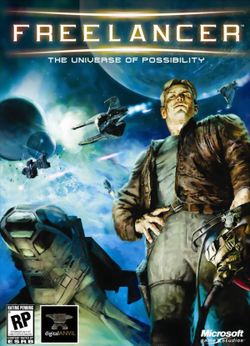
Well, you can never let it be said that we don't provide timely reviews here at SRV. I recently finished the single-player campaign in Microsoft's space combat simulator Freelancer, which came out in...March 2003. Since the game is three years old and has been dissected in some detail already, I'll be lazy and just confine this to some brief comments.
Wing Commander is still the best space combat game ever done. From the epic missions to the storyline that draws you in to the desparate struggle between the Kilrathi and humanity, Wing Commander remains a certifiable masterpiece. So, needless to say, I'm a huge fan of Chris Roberts' computer games (though, not his movies...yech). When I first heard of Freelancer in 1998 or so I was therefore really interested. Then the game experienced about 1 jillion delays, and then Microsoft decided to replace Roberts as the designer after buying Digital Anvil. Reportedly, much of Roberts' design was jettisoned in the process. Would the game be any good?
The answer is a resounding yes. Considering the game's protracted develoment cycle, that's nothing short of astoninshing. There's a lot to like here, including:
- The involving and detailed science fiction game backstory;
- The large and expansive universe, which was also put to very effective use (and was fun to explore!);
- The great character animations, including some impressive lip sync effects;
- The excellent voice acting;
- The graphics still hold up pretty well three years later; and
- The engaging plot, which really pulled you in and gave you the feeling that you were alone against the universe and on the run.
But...the game did have some issues. Some of these have been covered by others, so I'll focus on the lowlights:
- NO JOYSTICK SUPPORT! Whoever thought this one up deserves to be hit with a rubber chicken. I'm not complaining from the fact they made the game mouse-friendly; there's nothing wrong with that. What I'm complaining about is that the you didn't even have the option to use a joystick! This one oversight/monumentally bad decision/terrible idea/boneheaded notion was my biggest problem with the game. Talk about alienating your built-in fan base. Without the ability to use my trusty rusty WingmanForce3D, this game was significantly less fun for me. Note to the brainless executives who thought that eliminating the best peripheral device for space combat sims from their space combat sim would boost sales: Two of my friends didn't purchase the game simply because it didn't have joystick support.
- The single player campaign was a little on the short side and felt a bit rushed at the end. Not really a complaint, just an observation.
- I could go on for a few pages here about how the solar systems portrayed in the game were very, very, very scientifically inaccurate, but in honor of April Fool's day, I'll pass.
- The designs of the ships were really bizarre. I guess the best thing to say here is, "They tried." The game's producers must have told their art department to take every previous space combat sim and do the exact opposite, with decidedly mixed results. To be fair, since the ships were being transported up and down by space elevators, they didn't need to be aerodynamic, and real spaceships don't really need to be aerodynamic either. Plus, they really did make an effort to give every clan a distinctive spaceship style. However, they really didn't succeed in pulling it off. Maybe I know too much about real space vehicles or got too used to Wing Commander-style ships, but most of the spaceships were visually unappealing or even offputting. My "favorite" was the ship with a cattle catcher on the front. Gak.
- Did I mention that the game didn't have joystick support? Did I mention what a seriously stupid idea that was? Good.
On a side note, the fact that Microsoft didn't include joystick support in Freelancer, quit making the Sidewinder series joystics, and (if CGW can be believed) is poised to not even include joystick support in its XNA architecture has me worried. Although I find it hard to believe that they'll remove joysticks completely, especially with Flight Simulator X on the way, stranger things have happened.
Subscribe to:
Posts (Atom)


 Posts
Posts

